Introduction
In 2015, I was fortunate enough to be able to attend the 2015 Stockhausen Courses and Concerts held in Kürten (July 11-19, 2015). This article will have some general material on the Courses themselves, followed by some personal impressions of this unique experience
(in green). Every participant's experience will be different, of course, depending on his or her goals, and besides the many things I was looking forward to, my main objective during this visit was music research on works which I had not yet written about on this site. However, I did find time to sample (almost) everything, at least as an observer.
History
In 1998, Stockhausen initiated a yearly summer study and performance program near his home in Kürten, Germany, with each of the "Courses" lasting 10-17 days. Stockhausen had previously taught at or initiated other "new music" summer study programs (such as the Darmstadt Internationale Ferienkurse für Neue Musik and the Kölner Kursen für Neue Musik), and the Stockhausen Concerts and Courses were probably designed in a similar spirit - but concentrating on just his own works. Here he could host discussions of his works, offer composition seminars, have his works taught from experienced Stockhausen interpreters, and present almost a dozen concerts featuring music from his entire oeuvre, as well as premier new works. From a musical analysis standpoint, the most fascinating event might be Stockhausen's week-long composition class on one or more of his works (with demonstrations on a fully-spatialized surround-sound system). During the Courses, the composer was also generally available for questions and discussion during and in between rehearsals for the evening concerts. Besides overseeing rehearsals with the concert performers, Stockhausen also did the sound mix projection for every performance. The
BBC Music Masters Stockhausen DVD shows him during a Courses dress rehearsal for a performance of
3X REFRAIN 2000, which gives a good idea of the rigorous standards he holds the performers up to.
Since Stockhausen's death in 2007, Kathinka Pasveer and other close collaborators of Stockhausen's have taken over the sound projection role, and the "lecture" aspect of the courses has been distributed among guest musicologists, musical interpreters, composers, theologians, philosophers, blog writers (such as myself), etc... The focus of the lecture/seminar topics has thus expanded from pure musical analysis to also include topics revolving around symbolism, theology, philosophy, staging, etc... In all other respects, the activities of the Courses have continued on under the direction of Kathinka Pasveer and Suzanne Stephens.
Participants
The participants of the Stockhausen Courses come from all over the world, and are made up of composers, musicologists, musicians and music fans of all ages and musical backgrounds. One of the main aspects of the Courses is for aspiring musicians to learn directly from Stockhausen and his chosen musical interpreters (who have all made premier recordings for the Stockhausen Edition CDs) during master classes and private sessions. During the week, a few "Participants' Concerts" are held, and a few attendees (who have prepared works up to Stockhausen's standard) are selected to perform at these. At the end of the week, a prize ceremony is held, rewarding the best performances. Many of the premier recordings of Stockhausen's works since the Courses began actually feature former Course participants who have been subsequently invited to stay at Stockhausen's home to learn and record new works. Others have gone on to record Stockhausen repertoire for their own solo CDs (most recently,
Vanessa Benelli Mosell).
During Stockhausen's lifetime the number of attendees regularly exceeded 130, but since Stockhausen's passing, that number has somewhat decreased
(update - the attendance for the 2017 Courses has soared to its former numbers since my visit in 2015). However, the concerts and the musicianship of the performers have, if anything, thrived in quality, and every year new generations of youthful interpreters attend, learn, and go on to perform Stockhausen works in their own countries with different ensembles.
As a "musicologist", my personal goal (besides simply enjoying the concerts and meeting fellow Stockhausen fans) was to gain access to the wealth of scores and recorded materials, and do research on the works which I have not yet written blog entries on (as well as make corrections to previous entries). Additionally, by contacting the Stockhausen Foundation prior to my visit, I was able to request unpublished and unreleased materials and recordings in which I was interested in for examination. A few months prior to the Courses I was also given the opportunity to present my own "informal" lecture and moderate a discussion forum. I offered to give talks about the works which were being presented in the evening concerts, since the official pre-concert talks were all going to be held in German (the language used at the courses is English).
Daily Schedule
Each year (bi-annual since 2013 to make room for the Darmstadt Summer Courses), the "timeplan" for the Courses is different, but in general the schedule is fairly consistent.
In the morning, Alain Louafi (
INORI, DONNERSTAG AUS LICHT, MONTAG AUS LICHT, etc...) holds yoga and
INORI classes (teaching of the INORI body gestures).
In some years, this morning period also featured an
"intuitive music" workshop presented by the Ensemble for Intuitive Music Weimar, where participants could learn works from
AUS DEN SIEBEN TAGEN or
FÜR KOMMENDE ZEITEN.
During my stay at the Courses I stayed at the Hotel Tritz, which is walking distance to the school where the Stockhausen Courses are held. During breakfast, I met fellow hotel guests who were entirely Stockhausen musicologists and musicians, such as Rudolf Frisius, Robin Hartwell, Ian Parsons and Rumi Sota. These breakfast discussions would invariably plunge me into immediate "Stockhausen-mode", and lead to hours-long discussions of unusual (for me at least) depth. For this reason, I never actually made it to the INORI classes, despite my initial plan to check them out. Hopefully next time...
In the latter part of the morning, the concert hall holds a
dress rehearsal for the evening's performance. This rehearsal also gives the attendees an excellent insight to the performance preparation of Stockhausen's works. This period also functions as a kind of "sound projection course", in that the participants can be close to the mixing desk and can interact with the sound and light mixers. Perhaps the best aspect of the dress rehearsal is the chance to experience a (usually) full performance of the works scheduled for the evening. Stockhausen's works, perhaps more than any other composer I can think of, are best appreciated over repeated listenings.
 |
| Score/music study room/shop |
During the day, for those who do not attend the dress rehearsals, the
score library/shop is open as well as the
video room. This gives the participants the opportunity to study, listen to and watch all of the scores, CDs and DVDs sold by the Stockhausen Foundation. Basically, scores and CDs of every work are available for study, and many books written by Stockhausen and others are available for study at one of the many reading tables. Musicologists can also inquire ahead of time to request archival materials such as unpublished sketches and unreleased recordings and videos.
Since my main focus this year was to concentrate on the scores and archival materials, I usually spent my mornings after breakfast in the score room or video room, writing down notes for future blog entries. However I was able to attend a couple of the dress rehearsals (LAUB UND REGEN, UD, TRUMPETENT) and it was fascinating to see how these very specifically-staged works were polished and sometimes altered to solve any problems (almost all of Stockhausen's works require demanding stage movements and costuming). LAUB UND REGEN was an interesting example of seeing the process at work. This work was originally designed to be performed by a male and female couple in a somewhat sexually-charged setting, but in this case two women were performing it. Prior to the Courses they had together reworked some of the stage setting to create a more "sisterly" chemistry, and it was fascinating to see one of the original performers of LAUB UND REGEN (Suzanne Stephens) assist the two female musicians in realizing their own interpretation.
After lunch (catered and provided onsite for a small fee) the regular
lectures or presentations are given in a seminar room equipped with sound and visual projection equipment, as well as the simultaneous continuation of rehearsals in the concert hall. The lectures and presentations are given by a veritable who's who of
Stockhausen writers and specialists from many different disciplines, and
range from very detailed high-level musical analysis to more lay-oriented
discussions of the meanings and spiritual aspects of Stockhausen's works. Sometimes presentations are given by performers from the evening
concerts explaining the pieces they will play, or sound designers working on new electronic realizations of
Stockhausen's early works. After a prepared presentation, a question and answer period
usually follows. One of the most rewarding aspects of the lectures is to be exposed to new ways of approaching Stockhausen's music, or to hear archival recordings of individual tracks from Stockhausen's electronic or electro-acoustic works.
This year, there were 9 presentations with discussion:
- Joe Drew: Stockhausen's Approach to Narrative & Character
- Ed Chang: Overview of the works being performed in the evening faculty concerts and an explanation of the super-formula (2 sessions)
- Ian Parsons: The LIGHT within: What the symbolism of LICHT tells us about ourselves
- Thomas Ulrich: Music and Reality in the works of Stockhausen
- Sean Williams on his new realization of STUDIE II and his research on GESANG DER JÜNGLINGE using the original material tapes
- Juan Verdaguer on his interactive digital educational project GESANG DER JÜNGLINGE
- Gustavo Alfaix: Transreality in ORCHESTER-FINALISTEN
- Rudolf Frisius: Systematisation, Polarisation and Integration: Central aspects in Karlheinz Stockhausen’s Music
My two presentations were basically sourced from my blog entries on Stockhausen: Sounds in Space, but greatly enhanced with new visual aids and diagrams. In fact, I actually approached the LICHT superformula explanation in backwards order (retrograde!) from my original blog article, since in retrospect that seemed more natural (the other works which I covered were MICHAELs REISE UM DIE ERDE, TELEMUSIK, COSMIC PULSES, DÜFTE-ZEICHEN, LICHTER–WASSER, and SIRIUS, as well as a little bit about Xi, HARMONIEN, and GESANG DER JÜNGLINGE). In general, all of the talks of the presenters were well-received and illuminating, and I even learned some key insights during the Q & A portions of my own presentations (which of course, have since been incorporated into the already-published blog entries here). Usually either Kathinka Pasveer and/or Suzanne Stephens were present to add additional commentary (or make corrections!). One of the concerns of these presentations is that there is such a wide spectrum of familiarity with Stockhausen's works among the audience members, and it is at times difficult to gauge at what academic level to present one's subject. In my own talks I basically started from "ground zero" and worked my way up as far as I could go. The post-presentation discussions would lead to either simpler or more academic conversations, depending on the more vociferous audience members.
In the late afternoons from 1998 to 2007, Stockhausen conducted a daily composition class
in the main concert hall, providing detailed explanations with
musical examples of key works from his past or works which were being
premiered that year. The course books for these classes are available for purchase from
the Stockhausen website, and feature facsimile sketches (as well as lecture transcriptions in English for the 2001-2007 classes). These composition
classes were
as follows:
|
Also in the afternoon (after the seminars/presentations), the instructors for piano, brass, winds, synthesizer, percussion, etc... give
master classes to small groups of musicians, some of whom have prepared works in the hopes of performing one of them at one of the evening
Participants' Concerts. These master classes are crucial to the understanding and performance of Stockhausen's works because many times a published score may have been further revised or corrected, and only in the master classes can one learn the (unpublished) additions or alterations. The master classes also give the student interpreter the opportunity to see how the movement instructions are executed, which can only be partially described by score text and photographs. The instructors also all have a very precise sense of dynamics and tempo, and this is important because these aspects of Stockhausen's works are especially difficult to perfect without an instructor who has previously performed these works under Stockhausen's supervision, and the requirements of Stockhausen's works typically go well beyond the fine-tuning of most classical repertoire. Finally, since the instructors are typically the performers for whom the work was originally written, they can provide background information on the development and subtext behind these works, as well as describe how they themselves overcame difficulties involved with the execution of difficult passages.
Again, due to my concentration on the scores, I was only able to attend a couple master classes by woodwind performer Suzanne Stephens and flautist Kathinka Pasveer. The pieces taught at the classes I attended were IN FREUNDSCHAFT, Xi, and DER KLEINE HARLEKIN. As mentioned above, the attention paid to detail and the revised corrections to the scores were extremely valuable to the student performers. As an observer, hearing the careful shaping (and re-shaping) of isolated passages of a seemingly simple work such as IN FREUNDSCHAFT gave me a much greater appreciation of the craft of Stockhausen's specific articulations. Too often I probably concentrate too much on analyzing the pitches and durations at the expense of the dynamics and tempi, and the slow, methodical navigation through these aspects of the work revealed to me new narrative layers hidden in the more surface-level melodic shapes. It was clear after these classes that every articulation marking in a given measure (and there are usually quite alot!) serves a specific purpose and gives each line an "inner life".
Besides the scheduled master classes, some students also can schedule private lessons with faculty members. I was fortunate enough to be invited to attend a session where Hubert Mayer (tenor) and Merve Kazokoğlu (basset horn) rehearsed MONDEVA, in preparation for the staging of Stockhausen's opera DONNERSTAG AUS LICHT, in Basel in 2016. In other words, if one is lucky, one can actually experience a few "extra" Stockhausen works not on the Courses concert program (in a more informal setting, naturally).
 |
| Kathinka Pasveer performs SUSANIs ECHO |
After dinner, an
introductory talk for the evening concert takes place (in German and geared towards the more casual concert-goer, since all concerts are free to the public), which is soon followed by the evening performances. These
concerts are probably one of the main attractions of these Courses, and provide the attendee a perfect opportunity to experience Stockhausen's works in up to 16 sound channels in an acoustically-perfect setting. Since these concerts were/are produced by Stockhausen or his personally-trained sound projectionists, the listener can be assured of a performance and listening experience up to the standards of the composer himself.
The level of musicianship in the concerts is of a nearly superhumanly high standard (which
almost goes without saying for Stockhausen works), but one of the most rewarding aspects of seeing
Stockhausen's music performed live is that there is almost always a
visual layer expressed in the body movements of the instrumentalists and singers. In
every work Stockhausen includes physical gestures designed to highlight
or otherwise demonstrate facets of his music, such as the "tracing" of the melodic line in IN FREUNDSCHAFT, or the gestural narrative in the "songs" of
DÜFTE - ZEICHEN. These and other works which have performer movement as integral parts of the performance (such as
INORI,
AVE,
DER KLEINE HARLEKIN,
TRUMPETENT, etc...) can only be partly appreciated from a CD recording.
The majority of the concerts in recent years feature solos, duos or trios, though sometimes a larger ensemble may be gathered to perform a chamber orchestra work (such as
SIRIUS,
PROZESSION,
KURZWELLEN,
MICHAELs REISE UM DIE ERDE for Trumpet and 9 Soloists, etc...). If a live orchestra is not present, there is still ample opportunity to hear larger ensemble works, since multi-channel recordings of some choral or orchestral works are projected from spatially-accurate speaker locations (
CARRÉ,
MIXTUR,
LICHTER–WASSER,
ENGEL-PROZESSIONEN, etc...). Additionally, multi-channel electronic works (
GESANG DER JÜNGLINGE ,
HYMNEN,
COSMIC PULSES,
OKTOPHONIE, etc...) are projected in surround sound in Stockhausen's specified spatial orientation.
Besides the scheduled "faculty concerts", there are usually around three Participants' Concerts, as described earlier. These are often almost as superbly-executed as the faculty concerts, but usually consist of soloists or duos. The most common works performed by the participants are pieces such as IN FREUNDSCHAFT, one or more of the KLAVIERSTÜCKE, DER KLEINE HARLEKIN, KONTAKTE, ZYKLUS, TIERKREIS, soloist's versions of SIRIUS, and various solo or duo extracts from the LICHT operas. All of these participant performances include full dress/costuming, body movements and spatial projection from the mixing board, just as in the faculty concerts. The dress rehearsals for these concerts also serve as a final master class, taught by Stockhausen (when he was alive) or the master class faculty instructors.
 |
| Barbara Borowicz performs IN FREUNDSCHAFT for clarinet, during a Participants' Concert. |
I attended every concert (naturally) and frankly it is now kind of a blur, but it can safely be said that it was the richest sustained flow of musical wonder I've ever experienced without actually being one of the main performers myself :-). One of the nice things about the general seating arrangement (unassigned seats) is that it is possible to sit at different places in the auditorium in order to have a different listening experience than from a previous performance (such as from the morning dress rehearsal). For the electronic works this is especially rewarding. One thing I noticed was that since the speaker placement formed a very high sound space, it was often better to listen with my head tilted straight up, facing the ceiling. In this position, the sounds from the surrounding speakers could easily be visualized as swirling around before my eyes (for example, when listening to COSMIC PULSES or KONTAKTE).
I have to admit, this was probably the first time in 20-odd years that I had attended concerts with any kind of spatial projection beyond the normal "stereo" of a regular concert, and it was a bit disorienting for the first few days (also jet-lag...). The familiar stereo CD versions of the electronic works were here "spatially-exploded", and I think it was initially too much (newly-revealed) information for me to fully appreciate (especially for a super-dense 24-track work like COSMIC PULSES). Personally, it takes me many repeated listens to come to terms with a new Stockhausen piece, and so, when confronted with these spatialized versions of the pieces I knew so well (from decades of headphone listening), I felt like I had to start all over again at times (I suppose at heart I'm kind of slow to warm up to new experiences...). I can only feel pity for people who are used to the spatialized versions and they have to resign themselves to "mere stereo" at home! In any case, it's a great thing that I can "re-learn" these works in the future.
WDR Studio Tour
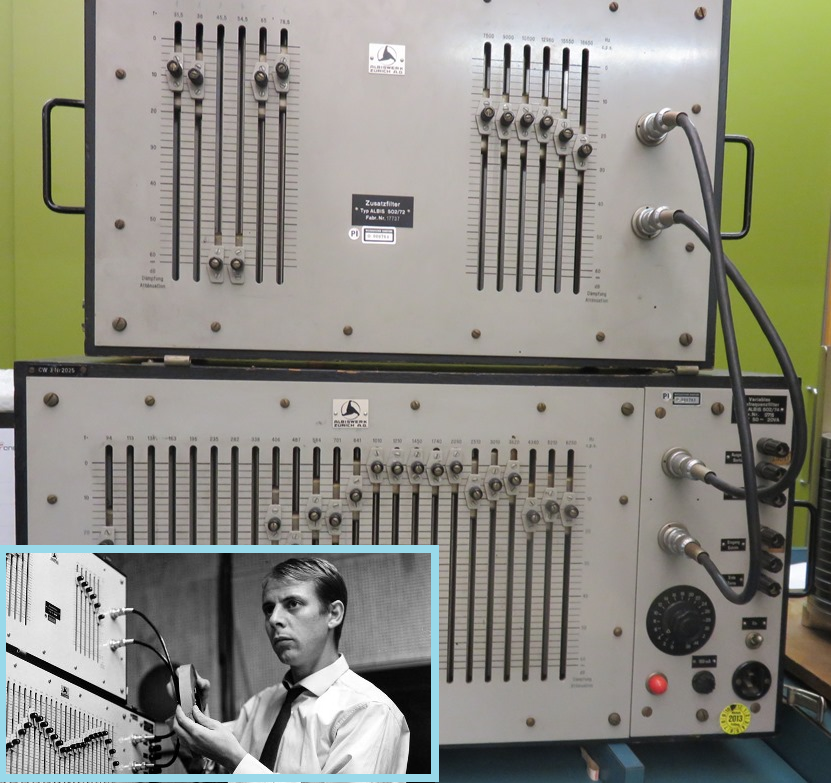
Aside from the Courses themselves, in recent years a tour of the WDR Electronic Music Studios museum/storage center is offered for a small additional fee. The original radio studio where Stockhausen created works like GESANG DER JÜNGLINGE, KONTAKTE and SIRIUS is no longer open, but almost all of the equipment of that studio has been preserved in a working space in Cologne (next to a fitness center, no less!). At this facility, the primary activity is the digitization of WDR analog tapes for archival purposes. One of Stockhausen's main collaborators at the original studio, Volker Müller, is present at these tours to talk about the equipment Stockhausen used, as well as demonstrate some tape loop manipulation techniques. Many essential artifacts from Stockhausen's career can be seen there, including the KONTAKTE rotation table, an EMS Synthi 100 (used in
SIRIUS), the "filters and potentiometers" rig which Stockhausen used with the 1960's Stockhausen Group (
KURZWELLEN,
AUS DEN SIEBEN TAGEN , etc...) and the EMS Vocoder (used to great effect in the concrete and electronic music of
PAARE vom FREITAG). Personally, this was another highlight, and the opportunity to have hands-on experience with some of these sine wave impulse generators (and the KURZWELLEN "filters and potentiometers" rig!) was priceless. My photo-tour of this facility can be seen
here.
 |
| Volker Müller during tape loop demonstration at WDR studio repository |
Final Remarks
Besides all of the "official activities" described above, another no less rewarding aspect of the Stockhausen Courses is the chance to meet and share knowledge with many other fans, researchers and interpreters of Stockhausen's works. The atmosphere is extremely casual, and all of the musicians and vocalists which one has heard on the Stockhausen recordings (who are teaching that year, of course) are available for casual conversation and to answer questions in between master classes and rehearsals (or at lunches). In fact, I have to thanks Benjamin Kobler especially for the time he spent explaining to me some key aspects of
KLAVIERSTÜCK VI which I have never read before (but now seem so obvious in retrospect!).
All of the student participants were in general very approachable,
and showed great respect for Stockhausen and his music. Even after spending so much time studying and writing about Stockhausen's works, I was constantly surprised by how much more I learned,
and how much deeper the "Stockhausen rabbit-hole" goes. Beyond the
purely musical analysis which I concentrate on in this blog, it was also very
interesting to hear some multi-disciplinary approaches to Stockhausen's
works as well.
Finally, Kathinka Pasveer and Susanne Stephens were an integral part of Stockhausen's life when he was alive and since his passing are the main overseers of Stockhausen's legacy. Because of this they are a great fount of information on Stockhausen's inspirations, working methods, spiritual aspects and general personality (besides being a primary source for all information related to Stockhausen's woodwind works and sound projection practices). They are both also extremely genial and patient! Perhaps the only downside to the Courses is the tendency to gain some weight from eating the rich German fare...
Below is a listing of the concert works presented by the faculty for the 2015 Courses, followed by a list of the works performed by the participants. Sound projection for all concerts was realized by Kathinka Pasveer (except for a few performances by Florian Zwißler).
| 2015 Faculty Concerts |
MICHAELS-RUF
DONNERSTAGS-ABSCHIED |
4 Trumpets
5 Trumpets |
| TELEMUSIK |
Electronic
and Concrete music (2-channel projection) |
| MICHAELs REISE (Soloists’ Version) |
Trumpet soloist,
9 co-players and sound projectionist
(feat. trumpet soloist Paul Hübner) |
| SUSANIs ECHO |
Alto
flute (feat. Kathinka Pasveer) |
| HAVONA |
Bass
and electronic music (feat. Michael Leibundgut) |
| COSMIC PULSES |
Electronic
music (8-channel projection) |
| TRUMPETENT |
4 Trumpeters, tent |
| LICHTER – WASSER |
Orchestra with vocal soloists and synthesizer
(16-channel projection) |
| ROSA MYSTICA |
Tenor
and synthesizer (feat. Hubert Mayer) |
| KLAVIERSTÜCK VI |
Piano (feat. Benjamin Kobler) |
| KONTAKTE |
Tape, piano and percussion
(feat. Benjamin Kobler & Michael Pattmann) |
| UD |
Bass
and synthesizer (feat. Michael Leibundgut) |
| WEIHRAUCH |
Soprano,
tenor and synthesizer
(feat. Hubert Mayer and Csilla Csővári) |
| ARIES |
Trumpet
and electronic music (feat. Marco Blaauw) |
| CAPRICORN |
Bass
and electronic music (feat. Michael Leibundgut) |
| MIXTUR 2003 |
Orchestra
with ring modulation (5-channel projection) |
| GESANG DER JÜNGLINGE |
Electronic
Music (4-channel projection) |
|
The final day's Prize Ceremony for the musicians who performed in the Participants' Concerts.
(the trumpeters have already departed to prepare for a performance of DONNERSTAGS-ABSCHIED to mark the official end of the Stockhausen Courses)
|
| 2015 Participants' Concerts |
Xi |
Liam Hockley (clarinet) |
| IN FREUNDSCHAFT |
Barbara Borowicz (clarinet) |
| ARIES |
Sam Jones (trumpet
and electronic music) |
| KONTAKTE (2 performances) |
Helga Karen, Lucia Carro Veiga
&
Hajong Kim, Jaime Moraga Vasquez
(tape, piano and percussion) |
| NATÜRLICHE DAUERN 1, 8 , 9 |
Duccio Beverini (piano) |
| PICCOLO |
Stephanie Mills (piccolo flute) |
| LAUB UND REGEN |
Julia Lindner, Johanna Stephens-Janning
(viola and clarinet) |
| KLAVIERSTÜCK XII (video) |
Simon Smith (piano) |
| HARMONIEN |
Callum G`Froerer (trumpet) |
| PIETÀ |
Joe Drew (flugelhorn
and electronic music) |
 |
| TRUMPETENT with Joe Drew, Callum G`Froerer, Sam Jones, Christopher Collings |
Links
Official page of the Stockhausen Courses on the Stockhausen Site
Stockhausen Courses 2015 Facebook Page (more photos)
Announcement page for the 2015 Courses
Composition Course book Publications from Stockhausen Classes 1998-2007
Post-2015 Courses News Article with Susanne Stephens and Kathinka Pasveer
Tristram Williams on his experience at the Courses in 2006
Al Moritz text on his experiences at the 2001 Courses (Google Groups)
Overview of the Stockhausen Composition and Interpretation 2001 Courses (Connally, Truelove)
"Kürten and the Stockhausen Courses: an Introduction (of sorts)" - 2001, DAC Crowell
Journal D‘Un Musicologue a Kurten (Rigoni, French)
Stockhausen Courses Page from Stonebraker site (archive.org)
Sonoloco Report of a 2002 Stockhausen Composition Class
The Stockhausen Composition and Interpretation Courses (2004, Medić)
Concert History
Below is a historical listing of all of the prior faculty concerts presented at the Stockhausen Courses from 1998 to 2013. A "*" indicates "world premiere", and a "**" indicates "German premiere".
| 1998 |
ZYKLUS |
percussion |
| KLAVIERSTÜCKE
I - V, VII, X, XI, XIII, XIV |
piano, synthesizer |
| FLAUTINA |
flute with piccolo and alto flute |
| WOCHENKREIS |
basset-horn and synthesizer player |
| TRAUM-FORMAL |
basset-horn |
| NASENFLUGELTANZ |
percussionist and synthesizer player |
| OBERLIPPENTANZ |
piccolo trumpet |
| BIJOU |
alto flute, bass clarinet and tape |
| ARIES |
trumpet and 8-channel electronic music |
| TIERKREIS
(Trio-Version) |
clarinet, flute and piccolo, trumpet and piano |
| PIETÀ |
flugelhorn, soprano and electronic music |
| SYNTHI-FOU
(KLAVIERSTÜCK XV) |
synthesizer and electronic music |
| TELEMUSIK |
electronic music |
| AVE |
basset-horn and alto flute |
| KONTAKTE |
4-channel tape with piano and percussion |
| 1999 |
MONDEVA |
tenor and basset-horn |
| EXAMEN |
tenor, trumpet, dancer, basset-horn, piano |
| DRACHENKAMPF |
trumpet, trombone, synthesizer, tenor, bass, percussionist |
| VISION |
tenor, trumpet, dancer, synthesizer, tape |
| DONNERSTAGS-ABSCHIED |
trumpet live and tape |
| KREUZSPIEL |
oboe, bass clarinet, piano, 3 percussionists |
| SIGNALE |
trombone and electronic music |
| YPSILON |
flute |
| KLAVIERSTÜCKE
V - IX, XVI |
piano, synth, tape |
| IN
FREUNDSCHAFT |
trumpet |
| SCHLAGTRIO |
piano and 2x3 timpani |
| AMOUR |
flute |
| BASSETSU-TRIO |
basset-horn, trumpet, trombone |
| LUZIFERs
TRAUM (KLAVIERSTÜCK XIII) |
bass and piano |
| KATHINKAs
GESANG |
flute and electronic music |
| MANTRA |
two pianists with electronics |
| 2000 |
SIRIUS (Summer-Version, 3
performances) |
trumpet, bass, soprano, bass clarinet with electronic music |
| 3x
REFRAIN * |
piano, vibraphone, synth |
| KOMET * |
percussion and tape |
| KOMET *
(piano ver., KLAVIERSTÜCK XVII) |
piano and tape |
| FREIA |
flute |
| VORTRAG
ÜBER HU |
musical analysis of INORI |
| INORI |
2 mime soloists with tape projection of orchestra |
| KLAVIERSTÜCKE
I-V, XI |
piano |
| IN
FREUNDSCHAFT |
oboe |
| OBOE |
oboe with tape |
| SPIRAL |
oboe with shortwave |
| 2001 |
Scenes from FREITAG aus LICHT |
soprano, baritone, bass, flute, basset-horn, electronic music |
| ZYKLUS |
percussion |
| KLAVIERSTÜCK
X, XIII |
piano |
| EINGANG
UND FORMEL |
trumpet |
| TANZ
LUCEFA! * |
basset-horn |
| MISSION
UND HIMMELFAHRT |
trumpet and basset-horn |
| UNSICHTBARE
CHÖRE |
8-channel choral tape projection |
| NASENFLUGELTANZ |
percussionist and synthesizer player |
| SUKAT |
basset-horn and alto-flute |
| OBERLIPPENTANZ
(ens. version) |
piccolo trumpet, synthesizer player, 2 percussionists |
| MONTAGS-GRUSS |
electronic music |
| LUZIFERS
ZORN * |
bass, actor, synthesizer player, tape |
| DER
KINDERFÄNGER * |
alto flute with piccolo, two synthesizer players, percussionist, tape |
| 2002 |
EUROPA-GRUSS * |
winds and synthesizers |
| STOP und
START * |
6 electro-acoustic instrumental groups |
| MITTWOCHS-ABSCHIED |
Electronic and Concrete Music |
| OKTOPHONIE
(with SIGNALS, PIETÀ and SYNTHI-FOU) |
Electronic Music |
| KLAVIERSTÜCKE
XII, XIV, XVI, XVI |
piano |
| LIBRA |
bass clarinet and Electronic Music |
| "Fremde
Schönheit" |
Stockhausen lecture |
| Xi |
basset-horn |
| YPSILON |
flute |
| AVE |
basset-horn and alto flute |
| SOLO |
trumpet with feedback delay |
| STRAHLEN
* |
percussionist and tape |
| ARIES |
trumpet and Electronic Music |
| HYMNEN |
Electronic and Concrete Music (multichannel) |
| MONDEVA |
tenor and basset-horn |
| EXAMEN |
tenor, trumpet, dancer, basset-horn, piano |
| VISION |
tenor, trumpet, dancer, synthesizer, tape |
| DONNERSTAGS-ABSCHIED |
trumpet live and tape |
| 2003 |
RECHTER AUGENBRAUENTANZ (ens. ver.) * |
clarinets, bass clarinets, percussionist, synthesizer |
| KATHINKAs
GESANG |
flute and electronic music |
| KLAVIERSTÜCKE
I - XIV |
piano |
| YPSILON
(basset horn ver.) * |
basset horn |
| NASENFLUGELTANZ |
percussionist and synthesizer player |
| OBERLIPPENTANZ
(ens. version) |
piccolo trumpet, synthesizer player, 2 percussionists |
| CAPRICORN |
bass and electronic music |
| TIERKREIS
(Trio-Version) |
clarinet, flute and piccolo, trumpet and piano |
| CARRÉ |
for 4 choirs and 4 orchestras (4-track projection) |
| VORTRAG
ÜBER HU |
musical analysis of INORI |
| INORI |
2 mime soloists with tape projection of orchestra |
| 2004 |
QUITT * |
alto flute, clarinet, trumpet |
| TIERKREIS
Version 2004 * |
Tenor and Synthesizer |
| KLAVIERSTÜCK
XIII |
piano |
| SONNTAGS-ABSCHIED
* |
5 synthesizers |
| HELIKOPTER-STREICHQUARTETT |
8-track projection |
| KOMET |
percussionist, electronic and concrete music |
| PIETÀ |
soprano, flugelhorn and electronic music |
| MITTWOCHS-GRUSS |
electronic and concrete music |
| KLAVIERSTÜCK
VI |
piano |
| KLAVIERSTÜCK
XV (SYNTHI-FOU) |
synth and electronic music |
| ROSA
MYSTICA * |
tenor with synthesizer |
| ARIES |
trumpet and electronic music |
| DIE 7
LIEDER DER TAGE |
tenor and synthesizer |
| Xi |
flute |
| VIBRA-ELUFA
* |
Vibraphone |
| BASSETSU
* |
Basset horn |
| AVE |
basset-horn and alto flute |
| ENGEL-PROZESSIONEN |
choral (8-track projection) |
| 2005 |
LICHT-BILDER |
basset-horn, flute with ring-modulation, tenor, trumpet with
ring-modulation, synthesizer |
| DÜFTE-ZEICHEN |
vocal and electronics (8-track projection) |
| ENGEL-PROZESSIONEN |
choral (8-track projection) |
| STIMMUNG |
6 vocalists |
| KLAVIERSTÜCKE
I–V, VII–X |
piano |
| KLAVIERSTÜCK
XVIII * |
piano |
| MITTWOCH-FORMEL
* |
3 percussionists |
| NASENFLÜGELTANZ |
percussionist and synthesizer player |
| OKTOPHONIE |
Octophonic Electronic Music |
| MANTRA |
2 pianos with electronics |
| 2006 |
KATHINKAs GESANG |
flute and electronic music |
| LUZIFERs
ABSCHIED |
tape projection |
| HIMMELFAHRT
* |
synthesizer, soprano and tenor |
| LICHTER
– WASSER |
orchestral (tape projection) |
| FREUDE
** |
two harps |
| LIBRA |
bass clarinet and electronic music |
| NATÜRLICHE
DAUERN 1-15 * |
piano |
| HIMMELS-TÜR
** |
percussionist and a child |
| Dein
Engel wacht über Dir – Vier Sterne (aus AMOUR) |
saxophone |
| OBERLIPPENTANZ |
piccolo trumpet, synthesizer, 2 percussionists |
| TELEMUSIK |
Electronic Music |
| SONNTAGS-ABSCHIED |
tape projection |
| VISION |
tenor, trumpet, dancer, synthesizer, tape |
| DONNERSTAGS-ABSCHIED |
trumpet live plus 5-track tape |
| 2007 |
KLAVIERSTÜCKE I–V, VII–X |
piano |
| FREUDE |
two harps |
| VORTRAG
ÜBER HU |
musical analysis of INORI |
| INORI |
2 mime soloists with tape projection of orchestra |
| IN
FREUNDSCHAFT |
trumpet |
| KOMET |
percussionist and tape |
| CHÖRE
vom MONTAG aus LICHT |
choral (8-track tape projection) |
| HARMONIEN
* |
bass clarinet |
| HARMONIEN
* |
flute |
| HIMMELS-TÜR |
percussionist and a child |
| MITTWOCHS-ABSCHIED |
Electronic Music |
| MICHAELS-RUF |
4 trumpets |
| TRUoMPETENT |
4 trumpets |
| TIERKREIS
Version 2003 |
Tenor and Synthesizer |
| COSMIC
PULSES ** |
Electronic Music |
| OKTOPHONIE |
Electronic Music |
| 2008 |
ELEKTRONISCHE STUDIEN I und II |
Electronic Music |
| GESANG
DER JÜNGLINGE |
Electronic Music |
| KONTAKTE |
Electronic Music |
| HYMNEN |
Electronic Music |
| UNSICHTBARE
CHÖRE |
choral (8-channel tape projection) |
| COSMIC
PULSES |
Electronic Music |
| TELEMUSIK |
Electronic Music |
| OKTOPHONIE |
Electronic Music |
| MITTWOCHS-GRUSS |
Electronic Music |
| MITTWOCHS-ABSCHIED |
Electronic Music |
| ENGEL-PROZESSIONEN |
8-channel tape projection |
| DÜFTE –
ZEICHEN |
8-channel tape projection |
| ELEKTRONISCHE
MUSIK mit TONSZENEN vom FREITAG aus LICHT |
20-channel tape projection |
| GLANZ ** |
chamber sextet |
| INORI |
2 mime soloists with tape projection of orchestra |
| NATÜRLICHE
DAUERN 1– 24 |
piano |
| KLAVIERSTÜCKE
VI, XI, XIV |
piano |
| SYNTHI-FOU |
synth and tape |
| ZYKLUS |
percussion |
| CAPRICORN |
bass and electronic music |
| AVE |
basset-horn and alto flute |
| CARRÉ |
for 4 choirs and 4 orchestras (4-track projection) |
| MISSION
und HIMMELFAHRT |
trumpet and basset-horn |
| HOCH-ZEITEN |
choral and orchestral (8-channel projection) |
| 2009 |
ELECTRONIC STUDY II |
Electronic Music |
| GESANG
DER JÜNGLINGE |
Electronic Music |
| TELEMUSIK |
Electronic Music |
| KOMET
(KLAVIERSTÜCK XVII) |
synth, tape |
| HOFFNUNG |
string trio |
| SAMSTAGS-GRUSS |
brass ens. (stereo projection) |
| LUZIFERs
TRAUM (KLAVIERSTÜCK XIII) |
bass and piano |
| KATHINKAs
GESANG |
flute and electronic music |
| HYMNEN |
Electronic Music |
| ZEITMASZE |
wind quintet |
| PROZESSION |
tam-tam, viola, electronium or synthesizer, piano, microphonist, filterer
and level controller |
| PROZESSION |
laptops |
| BALANCE |
bass clarinet, English horn, flute |
| DIENSTAGS-GRUSS |
brass, synth and vocal ens. (stereo projection) |
| OKTOPHONIE |
Octophonic Electronic Music |
| KLAVIERSTÜCK
XVIII |
piano |
| HELIKOPTER-STREICHQUARTETT |
8-track projection |
| DONNERSTAGS-GRUSS |
chamber (stereo projection) |
| MONDEVA |
tenor and basset-horn |
| KLAVIERSTÜCKE
XII, XIV |
piano |
| DRACHENKAMPF |
trumpet, trombone, synthesizer, tenor, bass, percussionist |
| ARGUMENT |
tenor, bass, synthesizer |
| ELEKTRONISCHE
MUSIK mit TONSZENEN vom FREITAG aus LICHT |
20-channel tape projection |
| KONTAKTE |
4-channel tape with piano and percussion |
| LIBRA |
bass clarinet and Electronic Music |
| HAVONA
** |
bass and electronic music |
| LICHTER
– WASSER |
orchestral (8-track projection) |
| MONTAGS-GRUSS |
multiple basset horn and elec. keyboard instruments
(4-track projection) |
| DIE 7
LIEDER DER TAGE |
tenor and synthesizer |
| MONTAGS-ABSCHIED |
piccolo flute, multiple soprano
voice and synths
(4-track projection) |
| EUROPA-GRUSS |
winds and synthesizers (stereo projection) |
| URANTIA
** |
soprano and electronic music |
| MITTWOCHS-ABSCHIED |
Electronic Music |
| MUSIK IM
BAUCH |
6 percussionists and music boxes |
| COSMIC
PULSES |
Electronic Music |
| ENGEL-PROZESSIONEN |
choral (8-track projection) |
| SONNTAGS-ABSCHIED |
5 synthesizers (5-track projection) |
| 2010 |
HALT |
trumpet and double-bass |
| UNSICHTBARE
CHÖRE |
choir (8-track playback) |
| DONNERSTAGS-ABSCHIED |
5 trumpets |
| KLAVIERSTÜCKE
I -VI, X |
piano |
| PARADIES |
flute and electronic music |
| NATÜRLICHE
DAUERN 16–24 |
piano |
| INTENSITÄT |
intuitive music |
| CUCHULAINN |
soprano with synthesizer |
| ROSA
MYSTICA |
tenor with synthesizer |
| UD |
bass with synthesizer |
| UVERSA |
basset-horn and electronic music |
| MITTWOCH-FORMEL |
3 percussionists |
| HIMMELFAHRT |
synthesizer, soprano and tenor |
| TREUE |
bass clarinet, basset-horn, EB clarinet |
| MIKROPHONIE
I |
tam-tam, 2 microphones, 2 filters with potentiometers |
| KREUZSPIEL |
oboe, bass clarinet, piano, 3 percussionists |
| GESANG
DER JÜNGLINGE |
Electronic Music |
| SCHÖNHEIT |
bass clarinet, trumpet, flute |
| HIMMELS-TÜR |
percussionist and a little girl |
| TÜRIN |
door, rin and speaker (stereo play-back) |
| FREUDE |
2 harps |
| 2011 |
MICHAELS-RUF |
4 trumpets |
| NATÜRLICHE
DAUERN 7–15 |
piano |
| TELEMUSIK |
Electronic Music |
| NASENFLÜGELTANZ |
percussion solo |
| JUBILÄUM |
orchestra (tape projection) |
| LICHT-BILDER |
basset-horn, flute with
ring-modulation, tenor, tpt with ring-modulation, synth |
| STRAHLEN |
percussionist and 10-track recording |
| LUZIFERs
ZORN |
bass, actor, synthesizer player, tape |
| WOCHENKREIS |
basset-horn and synthesizer player |
| AVE |
basset-horn and alto flute |
| OKTOPHONIE |
Electronic Music |
| SIGNALE
zur INVASION |
trombone and electronic music |
| SYNTHI-FOU |
synth and electronic music |
| 3x
REFRAIN 2000 |
piano, celesta, vibraphone |
| UNBEGRENZT |
intuitive music |
| KURZWELLEN |
laptops |
| POLE |
2 singers |
| ORVONTON |
baritone and electronic music |
| TATE
YUNANAKA |
soprano, baritone and synthesizer |
| ZYKLUS |
percussion solo |
| ARIES |
trumpet and electronic music |
| MANTRA |
2 pianists and electronics |
| 2013 |
MICHAELS-RUF |
4 trumpets |
| SAMSTAGS-GRUSS |
brass ens. (stereo projection) |
| LUZIFERs
TRAUM (KLAVIERSTÜCK XIII) |
bass and piano |
| KATHINKAs
GESANG |
flute and 6 percussionists |
| EXPO for
3 |
2 vocalists and electronics |
| FREUDE |
2 harps |
| HYMNEN |
Electronic and Concrete Music |
| STIMMUNG |
6 vocalists |
| MITTWOCHS-GRUSS |
electronic and concrete music |
| KAMEL-TANZ
* |
bass, trombone, synthesizer and 2 dancers |
| THINKI |
flute |
| BASSETSU-TRIO |
basset-horn, trumpet, trombone |
| ROSA
MYSTICA |
tenor and synthesizer |
| KLAVIERSTÜCK
X |
piano |
| WACH |
intuitive music |
| KONTAKTE |
electronic sounds, piano and percussion |
| INORI |
3 mime soloists with tape projection of orchestra |
| (2013a) |
HERBSTMUSIK
(non-faculty production) |
 |
|