Showing posts with label Chamber. Show all posts

KONTAKTE - Electronic Music Techniques

(© www.karlheinzstockhausen.org)
No.12: KONTAKTE (Contacts)
for 4-channel tape
1958-60 (35:30)

also:
No.12 1/2 (ie 12.2) - KONTAKTE for tape, piano and percussion
No.12 2/3 (ie 12.3) - ORIGINALE (Originals), Musical Theatre with KONTAKTE (1961)  [90 min]

Part 3:

The first 2 parts of this analysis of KONTAKTE can be found in

Pulses and Sine Waves
     The basic sounds of KONTAKTE were mostly generated by a pulse generator which could create bursts of noise ("white noise clicks") at the rate of 16 clicks/second to 1 every 16 seconds, and with durations between 1/10000 of a second and 1-second. These "full-spectrum" noise impulses were then fed through a frequency bandwidth filter in order to produce pitches, noises and mixtures of both.  Other devices employed include reverb units and ring modulators.

Hardware
  1. Pulse wave generator
  2. Level-control amplifier
  3. Amplifier
  4. 12 different filters
  5. Reverberation unitEMT.140No 108
  6. Ring modulator
  7. Sine-Square-wave generators
  8. Low-tone generator
  9. Difference-tone ‘hummer’
  10. Four-channel variablespeed tape recorder
  11. 3 other three-speed tape-recorders connected to a patch board
  12. 3 Terz-filters (band pass)
  13. Hand-operated rotation table to be used with four microphones (up to 6 rotations per second)

Tape Loops
     The first phase of creating KONTAKTE was to create bits of tape loops with "source material" with which to work from.  These tape loops were then manipulated and processed in various ways.

     One of the ideas Stockhausen explored is that when periodic impulses are looped at high speed, they create stable tones (pitched drones).  However, by varying the placement of an impulse on a tape loop, a noise can be created, with the bandwidth related to the length of variation between the impulse placements and the proportion of irregular to regular rhythms.  A transition from a pure tone to a noise can be done by gradually varying the amount of regular periodicity in the tape loop.

Creating Structure X
  1. Record 60 secs of pulses with pitch zigzagging upwards.
  2. Speed up 10x to 6 secs (zigzag melody becomes rising tone color) .
  3. Record 30 seconds with pulses in decreasing speed (zigzag down) with pitch falling and then rising in a smooth curve.
  4. Record 45 seconds with pulses continuing to evenly slow down with pitch falling in a zig zag and then holding steady.
  5. Record 45 seconds with pulses continuing to evenly slow down.  7 pulses play a melody in the middle and then hold again, slightly lower.
  6. Final pulses have gradually altered "filter feedback time" so that the timbre becomes metallic.
  7. Combine result of 1-2 with slightly sped up result of 3-6.
  8.  Afterwards, the sound is filtered higher and higher.
     Interestingly, the final pulse frequency (160 Hz), generated through frequency filtering, is about the same at the beginning's 1st pulses (166 Hz), generated by the pulse generator. 

Score
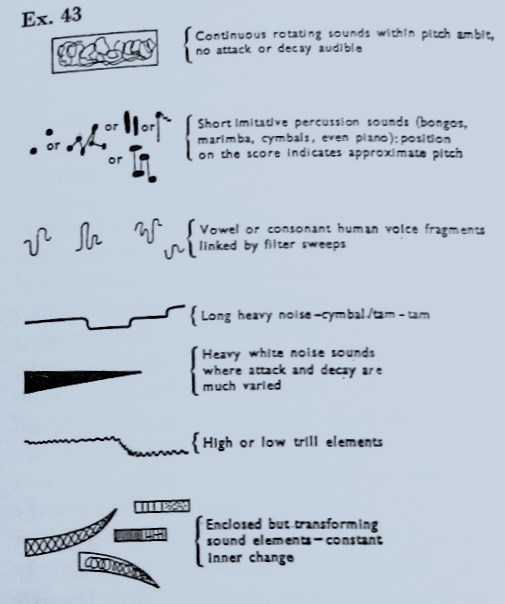
Score notations (from Jonathan Harvey's book)

The Realization score of KONTAKTE (cover at top of page) is basically in 4 parts:
  1. Pictures and descriptions of the studio equipment.
  2. Descriptions of the creation of 16 categories of tape loops.
  3. Descriptions of the mixing/manipulation phase for each of the 16 Structures.
  4. Visual transcription ("score") of the resulting electronic music.
     In contrast to every other article on this site, for KONTAKTE I've decided to refrain from charting out a beat-by-beat, impulse-by-impulse "listening guide".  Every time I hear KONTAKTE, the experience always feels like a "first time". For this reason I think I'll leave the "mystery" intact. In any case, the Stockhausen Edition has track breaks for each Structure, so one can easily follow the proceedings with an eye on "moment-structure" if one wants.

Live Performance
Structure XIIIB/C, from KONTAKTE w Perc & Piano
( © Universal Edition/© www.karlheinzstockhausen.org)
     KONTAKTE for tape, piano and percussion is the most commonly presented live version of KONTAKTE, as it has a very accessible visual element. The live instrumental parts were originally conceived as improvised accompaniment to the electronic tape (which is precisely what HYMNEN mit SOLISTEN is) but Stockhausen's initial auditions with this concept didn't produce the interactions he was looking for. He soon realized that he had to fully notate an accompaniment to the tape part. Thus, the score to KONTAKTE for tape, piano and percussion is one part graphic score (top staff) and two parts notated music (lower section). Stockhausen's compositional strategy for the piano and percussion elements could probably be best gleaned from the transcript below:

     "The instruments point at certain events in the electronic music, underline... It’s like having a painting with special coloring, and certain forms and figures are underlined with (this) color...they play along with what’s happening, sometimes even "multiply" - like at the beginning, the first two minutes, they really multiply what’s already happening in the electronic music."

 -  Stockholm Q & A transcript

      To get an idea of what Stockhausen is going for here, see the directives for the musicians in HYMNEN mit SOLISTEN.


ORIGINALE
     This piece is essentially a performance art theatrical work, involving many surrealistic characters and plot elements, many of them pretty funny. Part of the proceedings is a live performance of KONTAKTE with piano and percussion. This staging of KONTAKTE functions as a "performance within a performance". For video and more, check out the page on Ubuweb.

Sound Impressions
(see INTRODUCTION, or "I Remember KONTAKTE...")

Links
Sound samples, tracks listings and CD ordering
KONTAKTE Scores
ORIGINALE Score
Four Criteria of Electronic Music (Stockhausen on Music)
The Concept of Unity in Electronic Music (Stockhausen, PoNM 1)
Wikipedia Entry
Works of Karlheinz Stockhausen (Robin Maconie)
Electronic Music of Karlheinz Stockhausen (Heikinheimo)
Compositional techniques in the music of Stockhausen (1951-1970) (John Kelsall PDF)
Kontakte by Karlheinz Stockhausen in Four Channels (Kevin Austin)
On Stockhausen’s Kontakte (1959-60) for tape, piano and percussion (John Rea PDF)
"Zur Entstehungs- und Problemgeschichte der Kontakte von Karlheinz Stockhausen." (On the Origin and Problem of "Kontakte", Helmut Kirchmayer, in German, included with original Wergo LP)
Stockhausen Introduction for “KONTAKTE”, Stockholm, 12th May 2001
Stockhausen Q & A after KONTAKTE, Stockholm, 12th May 2001
Revisiting Kontakte (Talea Ensemble)
Relationships of Isomorphic Elements in Stockhausen's Kontakte (Stephen Lucas) 
The Music of Stockhausen (Jonathan Harvey)
WDR Electronic Music Studio Tour (photos of electronic gear, 2015)
WDR Studios Vintage Pictures & Video Tour (120 Years of Electronic Music)

DONNERSTAG AUS LICHT: Basel 2016

Detail of Basler Münster (Basel Cathedral)
Introduction
     On June 25th, 2016, a new production of Stockhausen's first opera, DONNERSTAG AUS LICHT (Thursday from Light) premiered at the Basel Theatre in Switzerland, with stage direction by the American-born, Europe-based Lydia Steier (with sets designed by Barbara Ehnes, costumes by Ursula Kudrna, and video effects by Chris Kondek).  This opera, the first in Stockhausen's LICHT opera cycle, originally premiered at La Scala, Milan in 1981, and was last staged in 1985 at Covent Garden in London.  For this third production, the opera received a fairly dramatic "makeover" in it's scenic design, setting, choreography and costuming.

     The original score for DONNERSTAG includes very detailed instructions for many elements of the stage production, and this kind of control is a hallmark of Stockhausen's compositional oeuvre, almost from the start of his career.  In this way, he manages to coordinate (or "harmonize") the music with the visual presentation of his works.  Stockhausen's designs for DONNERSTAG are detailed in this site's entries below:

Original Synopsis
     In short, the first Act, Scene 1, KINDHEIT, describes the youth of the main character MICHAEL as he is torn between the conflicting emotional and intellectual desires of his mother EVA and his father LUCIMON (this scene notably features many elements which reflect Stockhausen's own childhood).  Scene 2, MONDEVA, describes MICHAEL's encounter with a musical space creature named MONDEVA (Moon-Eve), and their attempts to communicate and learn from each other through melody.  In a tandem setting, Michael's mother and father are killed by euthanasia and war, respectively.  Scene 3 is an examination setting where MICHAEL explains his past experiences to a panel of four judges in order to "graduate" to his next state.

     In Act 2, MICHAEL pops in and out of different regions of a giant globe of the Earth, in effect "traveling" through 7 global regions and portraying MICHAEL's experience as a human being on Earth. Near the 7th Station, MICHAEL hears the basset horn call of EVA, an incarnation of MONDEVA, who he'd met in the 1st Act.  MICHAEL leaves the globe to pursue EVA, as a pair of mischievous wind players appear (but which are soon reprimanded and "crucified" by somber brass).  At the end, MICHAEL reappears with EVE and they play intertwining melodies as they "ascend" together.

     In the 3rd Act, MICHAEL has returned to a heavenly plane where he is welcomes by yet another incarnation of EVA.  The first part of the Act, FESTIVAL, presents highly ritualized sequences involving lighted gifts and images and other heavenly phenomena.  At one point a small globe-shaped gift opens to expel a devil-like incarnation of LUCIFER, and the MICHAEL-dancer is forced to battle this disruptive force.  After the devil has been defeated, yet another incarnation of LUCIFER appears at a balcony box and taunts MICHAEL and EVA.  In Scene 2, VISION, MICHAEL (still in his 3 incarnations of tenor, trumpet and dancer-mime) explains LUCIFER's origins in a musical-choreographic soliloquy.  He then explains why he took on a human form and experienced the pain and joy of growing as a human. Seven visions ("shadowplays") are projected on a screen which act as "time-windows" into his Earthly existence and subsequent return to the Heavens.  He ends DONNERSTAG AUS LICHT by proclaiming his love for Mankind.

     Overall, this opera has a premise which begins on a relatively mundane and localized premise (family/education), moves to a global setting (a semi-symbolic journey around the Earth), and then ends in a "cosmic" homecoming, with a few somewhat slapstick-ey moments thrown in to keep things from becoming too overly pompous (MICHAEL defeats the dragon-devil with the help of the orchestra conductor's baton stick, for example).

The Basel 2016 Production
DONNERSTAGs GRUSS in the Basel Theater's lobby stage, featuring a 70's lounge band playing Stockhausen music.
 (photo © Motoko Shimizu)
     The 2016 Steier production essentially revamps/remixes most of the elements of the opera except for the musical score itself.  In other words, everything that was not anchored with a treble or bass clef symbol was deemed open to revision.  Steier's team apparently felt that Stockhausen's original stage premise would need major alterations in order to make the opera more palatable to "contemporary audiences", and thus gave the visual narrative a much more cynical, self-parodying flavor, reducing much of the cosmic symbolism in the original staging to a more traditional opera narrative with a decidedly more "Earthly" through-line.

     The story begins the same, with Michael's dysfunctional childhood, but the euthanasia of Michael's mother becomes a more pivotal flash-point which is revisited in each of the subsequent Acts.  The stress of Michael's childhood causes him to have an apparent mental breakdown, during which he has an Oedipal fantasy (the father repeatedly shoots down auditioning Eve's in various states of moral undress, much to Michael's chagrin).  In the second Act, after admittance to a mental hospital, Michael travels not around the world, but only within the confines of the patient rec-room, and has video-projected hallucinations (partially induced through chemical means) about imaginary adventures in various global locales, .

     The third Act finds a grown-up Michael (as a Christ-like, Stockhausen-circa-1977 figure) becoming a kind of enlightened "guru" in a celestial church, and administering to a somewhat insouciant choir of "space children" acolytes.  Additionally, the dragon-devil figure which Michael fights in FESTIVAL takes on the post-modern costuming of a drag-queen, and in the end Michael becomes disillusioned with the dogmatic restrictions of his own church.  The final Vision scene features a 5-way soliloquy between the 5 incarnations of Michael characters from all 3 Acts, but with a curtailed selection of "mime-plays" concentrating on his relationship with his mother.

     A more detailed comparison between Stockhausen's original staging instructions and the Steier team's alterations follows (photos © Sandra Then, click to enlarge).

Act/Scene Original score setting Basel 2016 Staging
DONNERSTAGs GRUSS
(Thursday Greeting)
     Classical musicians perform in an opera house foyer-salon in traditional performance dress.      A somewhat lackadaisical cabaret band of smoking and drinking 70's-era beatniks perform as a lounge act.
Act 1: MICHAELs JUGEND (Michael's Youth)
Scene 1: KINDHEIT (Childhood)      Scene 1, KINDHEIT, describes the youth of the main character MICHAEL as he is torn between the conflicting emotional and intellectual desires of his mother EVA and his father LUCIMON (this scene notably features many elements which reflect Stockhausen's own childhood). 
     Scene 1 plays out relatively traditionally with Michael's attentions being baited by the mother and father, each at cross-purposes.  A central glass enclosure however includes the addition of dancers with giant mannequin heads miming a private family birthday party (one of the presents is a toy robot, which will make a reappearance in the 3rd Act).  The father-son hunting trip is arrived at with Michael riding on his father's back, instead of on a bicycle.  A video screen later shows the rather graphic skinning of a rabbit, as the mother is presented on a blood-soaked bed, having just miscarried (the original score features a short-lived infant brother).  In the original score, a dancer, LUCEVA, appears and the father flirts with her, but here the dancer appears only in the pantomimed birthday enclosure scene.
Scene 2: MONDEVA (Moon-Eve)
Original MONDEVA costume.
www.karlheinzstockhausen.org)
     MONDEVA describes MICHAEL's encounter with a musical space creature named MONDEVA (Mooneve), and their attempts to communicate and learn from each other through melody.  In tandem settings, Michael's mother and father are killed by euthanasia and war, respectively.
     The original score prescribes a simultaneous triptych of scenes between the 3 characters, but here the father and son's scenes are melded together into an Oedipal, Busby Berkeley-inspired fever-dream where a rotating succession of Moon-Eves are shot and killed by the father (these female images are drawn from the various women's magazines read by the Mother in the first scene).  Eventually the dream features a distant Eve's cry, which distracts the father long enough for Michael to shoot his father dead, after which Michael's interplay with Moon Eve continues normally.
Scene 3:
EXAM
     Scene 3 is an examination setting where MICHAEL explains his past experiences to 4 judges in order to "graduate" to his next state.
     Instead of a university thesis examination, here Michael is apparently strapped to a psychiatric bed and is tested by doctors with chemical and shock treatments.  The academic jury is here replaced by white-coated doctors with plastic noses.  At the end, Michael is deemed fit for what will soon be revealed as an insane asylum.
Act 2
MICHAELs REISE UM DIE ERDE
(Michael's Journey Round the Earth)
www.karlheinzstockhausen.org)
     In Act 2, MICHAEL pops in and out of different regions of a World's Fair-proportioned Earth globe, in effect "travelling" through 7 ethnic regions and portraying MICHAEL's experience as a human being on Earth. Near the 7th Station, MICHAEL hears the basset horn call of EVA, an incarnation of MONDEVA, who he'd met in the 1st Act.  MICHAEL leaves the globe to pursue EVA, as a pair of mischievous wind players appear (but which are soon reprimanded and "crucified" by somber brass).  At the end, MICHAEL reappears with EVE and they play intertwining melodies as they "ascend" together.


     Here, Michael journeys only within the confines of an insane asylum, populated with zombie-like mental patients being "treated" with cold water baths and other uncomfortable-looking therapies.  A seated audience of patients watches a film projection featuring images from around the 7 world stations (intended as a "soothing" video-therapy), as the overhead stage video screen simultaneously displays Michael and his dance and trumpet incarnations travelling "Monty Python-style" through dreamlike impressions of the 7 ethnic landing spots (Africa features graphic footage of lions killing and eating a deer, and Japan features an animated Godzilla from which Michael and his reflections are forced to flee).

     In the original staging of the scene, the Michael- trumpeter has a "consoling" duet with the contrabass, but here that aspect is visually ignored and only heard.  Instead, Michael acts as a "sane" person trapped inside an insane asylum (ie - "One Flew Over the Cuckoo's Nest"), and comforts a patient who resembles his mother.  In the finale of the Act, a Christ/Stockhausen-like figure (complete with a white, chest-baring shirt) appears, bathed in light.
Act 3: MICHAELs HEIMKEHR (Michael's Homecoming)
Scene 1: FESTIVAL
Covent Garden, 1985
(© www.karlheinzstockhausen.org)
     MICHAEL has returned to a heavenly plane where he is welcomes by yet another incarnation of EVA. FESTIVAL presents highly-ritualized sequences involving lighted gifts and other heavenly phenomena.  At one point, a small globe-shaped gift opens to expel a devil-like incarnation of LUCIFER, and the MICHAEL-dancer (as a toreador) is forced to battle this disruptive force when it changes into a dragon.  After the devil has been defeated, yet another incarnation of LUCIFER appears from the balcony and taunts MICHAEL and EVA.
www.karlheinzstockhausen.org)


     Foil-wrapped "acolytes" are seated on bleachers, as the Stockhausen/Michael/Christ figure ministers to a line of supplicants.  The old woman appears with the re-emergence of the toy robot from the first Act's birthday party.  Additionally a stack of video monitors arranged in the figure of a robot (inspired by Nam June Paik's work) is wheeled onto the stage, featuring a soundless, kaleidoscopic collage of Stockhausen's zoomed-in eyes and face, speaking (extracted fragments from archival interview footage).

     Instead of a drag(on)-devil appearing out of a globe, a drag-queen in gothic "Lolita" garb appears out of a giant birthday cake (again hearkening back to the first Act).  The Michael dancer (in a schoolboy uniform) battles the drag-devil.  Eventually the "real" Lucifer appears, not from the balcony or a crane, but as a ghost-like video-apparition from within the glass enclosure.
Scene 2:
VISION
     MICHAEL (still in his 3 incarnations of tenor, trumpet and dancer-mime) explains LUCIFER's origins in a musical-choreographic soliloquy.  He then explains why he took on a human form and experienced the pain and joy of growing as a human. 7 visions ("shadowplays") are projected on a screen which act as "time-windows" into his Earthly existence and subsequent return to the Heavens.  He ends THURSDAY FROM LIGHT by proclaiming his love for Mankind.      Michael climbs over the choir bleachers to end up in a starkly-lit space in order to give his final solo.  He is accompanied by the Michael trumpet and the other previous incarnations of Michael.  The video projects the moving lips of Michael (though sadly not synchronized to the live voice).  The reminiscences of Michael's previous episodes are recited, but the flashback "shadow-plays" are limited mostly to the disturbing fate of Michael's mother (death by gas, instead of injection) as the grown-up Michael struggles to save her through the glass walls.
DONNERSTAGs ABCHIED (Farewell)      The staging of DONNERSTAGs ABCHIED (Farewell) proceeds in the traditional manner, with 5 trumpeters performing from rooftops surrounding the exit of the opera house.

Final curtain call Basel 2016.
(photo © Motoko Shimizu)
Impressions
     This production of DONNERSTAG AUS LICHT obviously takes dramatic (no pun intended) liberties with Stockhausen's original score instructions.  For this reason, it might be worth considering this production to be a kind of "remix" or maybe more specifically a "collage", with Steier's premise to be one collage element, and Stockhausen's musical notes and rhythms as the other.  The first scene is more or less "faithful" (or at least within the realm of traditionally-accepted production changes),  but from the second scene on the degree of divergence increases to the point that in some scenes the libretto text (which, like the music, remains mostly intact) seems to be accompanying a completely unrelated stage action or image.  For example, the Moon-Eve scene has a text which is basically a flirtatious seduction, but the stage action features the execution of several prospective Eves without any consequence at all in the text - Michael just keeps on talking to the next Eve as if it were the same one as the previous one.  This strange juxtaposition of contrasting text and image has the effect of producing something like the dadaistic/impenetrably bizarre theater of George Foreman (for example).  However, if one follows the stage narrative without paying too much attention to the libretto, it actually ends up having a form of internal logic and consistency (I think).

     In any case, I was totally engaged and enthralled by the entire 6 hour experience, as the performances from the musicians and dancers were top-notch and at a level of which I'm sure Stockhausen himself would have enthusiastically applauded (the staging would probably have left him apoplectic).  However it often felt a bit like having the rug pulled out from under my feet due to the amount of divergence from Stockhausen's original staging instructions.  Certainly many in the "Stockhausen circle" have felt dismay at the amount of redressing done to Stockhausen's work, and Stockhausen himself frowned upon "remixes" of his work.  I personally wish that a version of DONNERSTAG AUS LICHT with Stockhausen's original premise were available as a film so that an "integral" version could be experienced by a greater audience.  Steier's vision is an interesting experiment and recommended viewing (as long as one accepts that it is a Stockhausen-Steier collaboration), but I also strongly believe that a "faithful" staging would survive a contemporary audience if done right.

     Lydia Steier's production of Stockhausen's DONNERSTAG AUS LICHT is presented at the Basel Theatre three more times in 2016: September 29, October 1 and 2, during the end of the GALAXIE STOCKHAUSEN, a Stockhausen mini-festival from Sept. 26 to Oct. 2.
Listening to DONNERSTAGs ABSCHIED performed from 5 rooftops outside of the Basel Theater,
with Elisabethenkirche in the background.
(photo © Motoko Shimizu)
Links
DONNERSTAG AUS LICHT at Theater Basel Page
Program (PDF, includes a revealing interview with the Basel production team in German)
English Libretto (PDF)
Trailer 
Lydia Steier Page

Reviews
Rolf Kyburz Review (English)
Ben Harper Review (English)
"Oppressive Intense Psychodrama" BR Klassik (German)
NMZ.de (German)
SWR.de (German)
NZZ Welt (German)
der-neue-merker.eu (German)
"Devil from a Cake": Stuttgarter Nachrichten (German)
"Engel für Charly": van.atavist.com (German)
"Kürtener's Astonishment at a Radical Staging": Bergische Landeszeitung (German)
Die Deutsche Bühne (German)
OMM (Online Musik Magazin) (German)
ResMusica (French)

KONTAKTE - Planning & Design

www.karlheinzstockhausen.org)
No.12: KONTAKTE (Contacts)
for 4-channel tape
1958-60 (35:30)

also:
No.12 1/2 (ie 12.2) - KONTAKTE for tape, piano and percussion
No.12 2/3 (ie 12.3) - ORIGINALE (Originals), Musical Theatre with KONTAKTE (1961)  [90 min]

     A discussion of KONTAKTE should probably start with my post on Stockhausen's "4 Criteria for Electronic Music".  That link should be read first, since it acts as an introduction to this more detailed analysis.  It basically summarizes some of the most important ideas featured in KONTAKTE.  

Development
     KONTAKTE is Stockhausen's 5th electronically-created tape work, after ETUDE, STUDIE I & II, and GESANG DER JÜNGLINGE.  The composition plan (consisting of about 700 sheets of paper) was written over 6 months from 1958 to 1959.  Afterwards, Stockhausen used these copious notes to create ("realize") this work at the WDR Electronic Music Studio (with the aid of technicians Gottfried-Michael Koenig and Jaap Spek, in between September 1959 and May 1960).  The premiere was on May 10 of 1960 at a festival concert for the International Society for Contemporary Music in Cologne. 
2 random pages (out of 700 total) from the original design notes of KONTAKTE.
www.karlheinzstockhausen.org)
     KONTAKTE marks Stockhausen's first "live" electro-acoustic work in the version with accompanying live instrumentalists.  In GESANG DER JÜNGLINGE, a boy's voice was used in the assembly of the electronic layers, but in this case, the "concrete" sounds would be "joined" at the moment of performance.  Originally planned as an electroacoustic work with 4 live performers playing scores with some aleatoric elements, it was eventually reduced to just tape, piano and percussion, with all of the live parts completely notated out.  After this, Stockhausen would move on to apply electronic signal processing to the live instruments ("live electronic music") in works such as MIKROPHONIE I, MIXTUR, PROZESSION, etc... During these years, the tape-only works TELEMUSIK and HYMNEN would also be major creations.  However, in many ways, KONTAKTE is Stockhausen's signature breakthrough work of this period, and possibly his entire oeuvre, which is saying quite alot, considering the incredible variety and breadth of his 57-year career. 

     From a compositional standpoint, this work is also the meeting point between 2 of Stockhausen's favorite devices.  In KONTAKTE, The synthetic sounds have elements of organized serial technique -  that is, properties such as pitch, duration, dynamics and timbre are organized using unique distribution sequences.  As mentioned in the "4 Criteria", the sounds were also organized with 42 different scales (with step intervals from 1/30th of a 5th up to an entire 5th), each one assigned to a timbre based on its "noise complexity".  The other major idea presented here is "moment form", in which a work is divided into short, consecutive sections which have varying amounts of shared characteristics between them, i.e. - the sections do not necessary have to be related to each other in any kind of traditional thematic way.  The concept of "moment form" was also featured in the concurrently-composed work, CARRÉ for choir and 4 orchestra groups (though moment form elements were hinted at as early as in GRUPPEN for 3 orchestras).

Contacts
     The title KONTAKTE refers to 3 kinds of "contacts":
  • CONTACT Between Sound Families: 
    • The acoustic (percussion) and electronic timbres of KONTAKTE were organized according 3 pairs of pitched and un-pitched sound families:
      • Metal 
        • Tones (crotales, cow bells...)
        • Noises (tam tam, gong, cymbals, hi-hat...)
      • Wood 
        • Tones (wood blocks, marimba...)
        • Noises (bamboo rattles/claves...)
      • Skin (membrane) 
        • Tones (tom-toms, bongos...)
        • Noises (bongos filled with beans...)
    • The un-pitched noise timbres also basically fall under the group description of "colored noises", meaning bandwidth-filtered white noise.   
    • The differences between these 6 basic sound-types were organized according to a transformation scale (dull to bright, etc...), and the use of electronics made it possible to create smooth transitions between these sound families (wood sound to a metal sound, etc...).  The piano and percussion parts essentially help to make different kinds of contact during these transitions (also, since the electronic sounds have microtonal scales, the piano often either doubles the chromatic occurrences or reinforces the percussion player's parts).
  • CONTACT Between Space Shapes:  The use of spatial movement around the listener (and distance from, to a lesser extent) is helpful in adding a dramatic element to serially-organized music, which can tend to have a "flat, pointillistic surface".  The title "Contact" refers to the connections between the spatial shapes created by the sound projection ("Raumgestalten").
  • CONTACT Between Moments:  As mentioned earlier, KONTAKTE is designed as a sequence of independent sections called Moments (usually coinciding with the Structures).  Since each of these Moments can be very different, the contact between these blocks of texture/narrative is another way to appreciate the title's meaning.  Each Moment is organized by sound family, proportion of pitch to noise, register and process (see below).
     This remainder of this post describes the organizational design phase of the composition of KONTAKTE.  I think it's significant that in his own 1972 lecture on KONTAKTE, Stockhausen talks much more about the "4 Criteria" and the final sounding result than these sketch plans.  However, these early sketches are an interesting look at Stockhausen's planning strategies for this watershed work.  A later post will go into the actual creation of the electronic music - the realized "performance" of the score, so to speak.

Moment Form Types and Partial Moments
     A work composed in "Moment Form" is basically a sequence of short, self-contained sections ("Moments"), which do not depend on a previous or a following Moment in order to "make sense".  In traditional classical music, a main theme (a "Moment"), is stated and then developed through variations (each another Moment).  This produces a kind of dramatic arc, and the theme is sometimes revisited at the end as a coda.  Sonata form is based on the development of 1 or 2 main themes, and in general the drama of these kinds of works is produced by the "journey" that the main theme takes.  In "Moment form", the Moments are regarded as "free-standing", so the flow does not have to be based on the forward development of a basic thematic Moment.  In other words, the sequencing is "non-linear", to borrow a term used in audio/video editing software.

     Related to this concept, Stockhausen also envisioned performances in which different works would be continuously repeated in separate rooms and an audience could move from room to room in order to get a "custom" musical experience.  Moment form is a logical solution to the potential problem of missing the beginning of a work.  Since each Moment is free-standing, there is no beginning.  Or possibly, any Moment could be a beginning, since the order of Moments is not based on a "story".

     Using terminology from Stockhausen's article "Momentform", the basic Moments in KONTAKTE can be characterized with 4 properties and the combinations of these properties: Gestalt (individuell), Struktur (dividuell), Zustand (Statisch), and Prozess (dynamisch), or GESTALT, STRUCTURE, STATIC and DYNAMIC.  When combined, these basically describe how divisible a Moment is, and if it develops in some way.  The below table shows 6 out of 8 possible combinations (2 are missing since there are no Moments which are both Static and Dynamic at the same time).

Static or Dynamic Gestalt or Structure Example of Moment type
Static State

(holding steady pitch ranges, tempo and/or dynamic) 
Gestalt
(individual, indivisible)
6 note chord/arpeggio (even rhythm) with all sounds similar timbre and dynamic.
Static sound density.
Structure (divisible) Repetition of different textures (pitch set, cluster, etc...).
Static intensity and lengths of the individual parts.
Combination One layer of repeating clusters with 1 layer made from a sustained pitch.
Static intensity.
Dynamic Process

(changing from one extreme to another, glissando, crescendi, etc..., usually more than 1 property)
Gestalt  Rising glissando.
Dynamically moving through space.
Structure Repetitions of points and clusters.
Dynamically decreasing intensity of each cluster group .
Combination Repeating sequence of 2 kinds of percussive accents using a narrow bandwidth of sound in even rhythm.
Dynamically slowing down and fading away.
     Seppo Heikinheimo's book, The Electronic Music of Karlheinz Stockhausen, conveniently breaks down every Structure and partial Structure into Gestalt, Structure, Static and Dynamic categories, but I think I will refrain from listing them all here, since it may be more rewarding in this case to just listen and make one's own assumptions.

Relationships of Isomorphic Elements
in Stockhausen's Kontakte (Stephen Lucas)
      Alternatively, Stephen Lucas describes KONTAKTE in slightly different terms in his paper, Relationships of Isomorphic Elements in Stockhausen's Kontakte:
  1. Directional (changing, often precedes peaks)
  2. Peaks (loud blocks, acts as transition, often precedes extinction of directionality)
  3. Extinction of directionality (quiet, static, acts as the end of a larger section)
  4. Static fragmentary (divisible but no change or pauses, various timbres)
  5. Directional fragmentary (divisible with change and pauses, contrasting dynamics)
  6. Instrumental cadenzas (imitations of acoustic instruments, phrases/clusters, preceded by fragment phases)
     Adapted from a paper by Alessandro Cipriani, it is essentially the same as Stockhausen's breakdown (directional = dynamic, extinction = static, peaks = gestalt, fragmentary = structure), but it has some interesting ways of looking at the sequencing of the whole structure.  Each of the 5 large group sections basically ends with a sequence consisting of Directional-Peak-Extinction.

     The Moments can also be viewed as being in 3 related levels of structural complexity: partial-Moments (a variation of a Moment), Moments (which are focused and individual), and Moment-groups (groups of Moments which may have an element in common).  The first Moment-group is Structure I, consisting of 6 Moments (usually a Structure is made of similar Moments).  The 2nd Moment-group however is made up of both Structure II and III.  For a partial-Moment, if a Moment has, for example, 6 different chords in an even rhythm (Gestalt-Static), each chord could be considered a partial-Moment.  These ideas of micro- and macro-Moments would be much further explored in MOMENTE, organized in a tree-like heirarchy.

Serialism
     A major difference from previous serial works such as KREUZSPIEL is that most scales here are qualitative, as opposed to quantitative.  In KONTAKTE, parameters space, instruments, form, tempo, register and dynamic are arranged on a qualitative scale of 1 to 6 (instead of the quantitative, measurable 12 for a chromatic pitch or tempo scale).  Each Structure/Moment is assigned 6 6-step serially-organized properties, resulting in up to 36 degrees of combined change.  Stockhausen calls this "Reihen der Veränderungsgrad" - serial sequences based of levels of transformations:
"from zero change to maximum change there are:
  • series of change (what changes)
  • degree of change (how much is changed)
  • predominant parameter where a certain degree of change is active (what is most changed)"
     For example, in the sketches for KONTAKTE, spatial movement in 6 scale degrees is expressed in 6 diagrams for the movement of sound in 1 and 2 dimensions (in a line to an adjacent speaker, or as a spreading "flood" to 2 speakers, etc...).

     Pitches, however, get a different set of rules, as they are arranged in 42 different kinds of scales depending on the bandwidth of the sound (as mentioned in "4 Criteria").  For the acoustic, pitched instruments (especially piano), a 12-note serial row (starting from A and expanding outwards by semitones) was used in various permutations to organize the pitches.  Rhythmically, they "underline" the electronic and acoustic textures.

Form Structure
     KONTAKTE was originally planned as 18 "Structures", with 6 subsections in each, but Structures XV-XVIII were not completed in time for the premiere (which was at the ISCM Festival in Cologne on 1960).  Stockhausen did, however, put together 2 introductory Structures, which act somewhat as an "overture and bridge" to the completed sections I-XIV.  For this reason, Structure III in the score is actually Structure I in the original sketch diagram, etc...  In any case, the final score of KONTAKTE has 16 Structures, with most subdivided into smaller sections.
KONTAKTE initial form plan sketch, reproduced in Richard Toop's
6 Lectures from the Stockhausen Courses
www.karlheinzstockhausen.org)

     In the above sketch plan, many Structures contain a 6 x 6 number matrix which is the 6 x 6 serially-organized properties (space, instruments, form, tempo, register and dynamic).  The ones written in blue (Structures II, V, VII, X, XII and XVIII) indicate the equal appearance of instrumental and electronic sounds, and ones in green indicate mostly instrumental sounds (however, this design was ultimately altered considerably, and electronic sounds are pretty dominant in all Structures).  The circled numbers below them basically give each Structure a rank based on the summed number matrices (a kind of "scale of transformation" between the Structures).

     Below the circled ranking numbers are 6 columns which visually show the "strength" of each of the 6 properties (contrary to most other form schemes, these have nothing to do with the passage of time).  The numbers below the black columns are durations.  At the lower part of the pages, marked in red, are initials indicating the planned sound family (usually for the percussion part) to be featured in each Structure (H = Holz, or Wood, M = Metal, F = Fell, or Skin (membrane), and G = Geräusch, or Noise).  The subscript numbers indicate register (1 = low, 2 = high).

     In other sketches and tables, Stockhausen organizes the predominant transformation types of Structures, distribution of the 6 sound families, the subdivisions into partial-Moments, and the mix of electronic to electroacoustic Structures (in the original plan, 6 were to be exclusively electronic).  There are also some markings which seem to hint that the amount of freedom for the originally-planned live, indeterminate sections was to be inversely proportional to the amount of structural transformation ("The smaller the transformation value, the larger the choice").

     Finally, during the creation of the electronic tape and the subsequent notation of the live instruments, KONTAKTE changed in many ways according to how the results of his sound experiments actually sounded "in real life".  This pattern of creating a plan, following through with it, and then "course-correcting" based on live performance practice, was a technique Stockhausen would use for his entire career.  In any case, these planning stage sketches of KONTAKTE provide an interesting look at Stockhausen's thoughts on how to organize and create a dialogue between electronic and acoustic textures in balanced proportions (though they differ dramatically from the final result).

Continue to Part 3: KONTAKTE - Electronic Music Techniques

Links
Sound samples, tracks listings and CD ordering
KONTAKTE Scores
ORIGINALE Score
Four Criteria of Electronic Music (Stockhausen on Music)
The Concept of Unity in Electronic Music (Stockhausen, PoNM 1)
Wikipedia Entry
Works of Karlheinz Stockhausen (Robin Maconie)
Electronic Music of Karlheinz Stockhausen (Heikinheimo)
Compositional techniques in the music of Stockhausen (1951-1970) (John Kelsall PDF)
Kontakte by Karlheinz Stockhausen in Four Channels (Kevin Austin)
On Stockhausen’s Kontakte (1959-60) for tape, piano and percussion (John Rea PDF)
"Zur Entstehungs- und Problemgeschichte der Kontakte von Karlheinz Stockhausen." (On the Origin and Problem of "Kontakte", Helmut Kirchmayer, in German, included with original Wergo LP)
Stockhausen Introduction for “KONTAKTE”, Stockholm, 12th May 2001
Stockhausen Q & A after KONTAKTE, Stockholm, 12th May 2001
Revisiting Kontakte (Talea Ensemble)
Relationships of Isomorphic Elements in Stockhausen's Kontakte (Stephen Lucas)
Problems of methodology: the analysis of Kontakte. Atti del XI Colloquio di Informatica, Musicale. 1995 (A Cipriani)
Six Lectures from the Stockhausen Courses (Richard Toop)
WDR Electronic Music Studio Tour (photos of electronic gear, 2015)
WDR Studios Vintage Pictures & Video Tour (120 Years of Electronic Music)

ZEITMASZE

www.karlheinzstockhausen.org)
Nr. 5: ZEITMASZE (Time-Measures)
for wind quintet (flute, oboe, English horn (cor anglais), clarinet, bassoon)
(1955-56)  [approx. 15 min.]

Development
     The title ZEITMASZE (ZEITMAßE) can be translated from German as "Time Measures", or even just simply as "Tempos".  The conception of its opening section came to Stockhausen whilst in the middle of composing GRUPPEN and GESANG DER JÜNGLINGE in Switzerland.  Like GRUPPEN, this work also explores simultaneous layers of contrasting tempos, and like GESANG DER JUNGLINGE, there are also 5 "tracks".  After its first performance for a radio broadcast, Stockhausen added 5 additional passages ("inserts"), and this new version was premiered at the end of 1956 at Pierre Boulez's "Domaine Musical" concert series (conducted by Boulez).

Tempo Concepts
      ZEITMASZE uses contrasting ("polyphonic") tempo layers as a way to create new and interesting rhythmic textures, much like how serial 12-tone technique was used to create unpredictable melodic and harmonic textures.  Serial technique is still used in the beginning and ending sections, but the main body highlights alternating waves of rhythmic unison and disintegration.  In order to create variety in these contrasting layers, Stockhausen used the idea of "indeterminacy", in which some factors are left to the performer.  In this case, the performer's actual playing skill becomes a deciding factor in the compositional end result (this idea was also explored just previously in the second set of KLAVIERSTÜCKE (V–X)).  So, when "tempo polyphony" is desired, Stockhausen notates the score using 5 basic "time measures":
  • "so schnell wie möglich": tempo as FAST as possible, based on the performer's skill level.  Since the rhythm within the tempo are still observed, if the phrase has lots of sustained notes, it could still seem slow, but with some very fast moments.
  • "so langsam wie möglich": as SLOW as possible, based in how slowly a number of bars can be played on a single breath.  Just as in the above instruction, if the group has lots of notes, the tempo could still seem fairly busy
  • "schnell-verlangsamen": Fast and then SLOWING down to 1/4 of the initial speed (ritardando)
  • "langsam-beschleunigen": Slow and then SPEEDING up to the fastest possible speed (accelerando, initial speed is pre-calculated to be 1/4 of the final "fastest" speed)
  • Metronome tempo: just as pitches are organized as a 12-note scale structure ("row") in dodecaphonic serial music, here Stockhausen created a "chromatic scale" of 12 tempo values from 60 to 120 (representing a tempo "octave").  The starting tempo is 84.
     Tempo polyphony occurs when different tempo instructions are used on different instruments playing at the same time, but often the above instructions can also used on an ensemble level (and combinations in between).  For example, the group tempo could be set by a lead instrument, who is playing "as slow as possible". Obviously, this presents some interesting challenges for the interpreters.

...present-day man, with his cars, planes and machines of all kinds, perceives time quite differently, 
since he often experiences - especially simultaneously - 
several speeds, time layers multi-dimensionally.
 - Stockhausen concert introduction, 1992


Tempo Structures
(Copyright Universal Edition)
     On the page above (starting at m.29), the players all start at tempo 112, but soon go off into their own tempo structures, starting with the 3rd staff English horn ("as fast as possible").  The 1st staff oboe follows with "as slow as possible", and then the clarinet (4th staff) begins to slow down to a quarter speed.  Later on the flute (2nd staff) will also start playing "as fast as possible", while the bassoon stays at 112 (bottom staff).  Each of these layers is demonstrated individually in Stockhausen's concert introduction of a 1992 performance (available on DVD, see link at bottom).  In this introduction Stockhausen goes on to highlight a few other interesting devices used in this work:
  • the ensemble begins in a slow tempo and rises to "as fast as possible", based on the ability of a lead player (ex. flute, m.74-76).
  • "window": layers of tempo polyphony suddenly thin out (pause) so that a solo layer can be featured.
  • "time body": accents from the other players occur on top of an English horn playing "as slowly as possible" (creating changing levels of density) (m.87-90?).
  • Ex. 11: each of the 5 layers modulates between "points" (isolated accents) and "groups" (legato phrases).  It ends in a rhythmic ensemble structure.
  • Ex. 12: demonstrates "time junctures", where different layers go from unison to independent time measures.
  • Ex. 13: shows where note clusters can occur as ensemble attacks with individual fade outs, or the reverse (individual voices enter and sustain, building to a vertical harmony, and then stop in unison).  Variations of both of these 2 extremes occur as well.

     Another effect (not highlighted in the concert introduction, but worth mentioning anyways) is that sometimes a tempo may be started by one instrument, and then continued in another.  This creates another level of indeterminate tempo (and timbre) polyphony.
(Copyright Universal Edition)
     On the above page, several tempo layers are occurring, but are also being exchanged between partner instruments (independently).  The top line oboe plays "as fast as possible", passing on its tempo to the clarinet at m. 164.  Prior to this, the clarinet speeds up to its fastest speed and hands off its tempo to the bassoon at m.162, which begins to slow down.  On the second staff, after the flute slows down to a quarter speed, the English horn picks up its tempo (m.163) and begins to accelerate to 4 times faster (original tempo).  A sudden stop interrupts all 3 active voices at stable tempo 112.

     Performance-wise, the conductor often beats out a notated underlying tempo (derived from the chromatic tempo scale), and then instruments marked with indeterminate tempo instructions "split off" from the ensemble and play independently.  Later they return, etc...  Much of the drama of the work comes from this element of "renegade players" leaving and then returning to the ensemble, just as harmony and disharmony creates drama in traditional classical music. 
 
     One of the most important ideas not mentioned so far is that the "homophonic" tempo sections (all instruments in shared tempo) should be listened to as single melodic "tracks", but with varying "widths" (harmonies).  In other words, when the ensemble is "tempo-together", there is often a constantly changing density of voices, from single pitches to 5-part chords, but these should not be thought of as a polyphonic "dialogue".  In actuality the melody is "monophonic", but has a constantly changing homophonic harmonization. By listening this way, the transitions to the "free tempo" sections become much more meaningful.

(Treated score excerpt from LP cover.)

Form Structure
     ZEITMASZE is basically in 3 sections.  The 1st and 3rd sections are short and somewhat similar (both composed using "total serialism" on several musical parameters), with the 3rd section being more rhythmically complex.  The long middle section (m. 30-271), on the other hand, is based on 7 "character types" organized into 4 cycles of different sequences.  The character types are:
    • groups, phrases
    • polyphonic layers
    • sustained notes & points
    • points
    • rapid chords or sounds, polyphonically, with long general pauses
    • chords
    • chords and a few independent notes, legato
           This main body is also where the contrasting "time measures" (polyphonic tempo layers) occur.  The 1st and 3rd sections also have changing tempi, but they are applied to the entire ensemble.

           Each of the 3 sections are also characterized by a "core instrumentation".  For example, the 1st section is written for a quartet made of flute, English horn, clarinet, and bassoon, the 2nd section is for a flute, oboe, and clarinet trio, and the last section uses the full quintet.  The players outside of the "core group" usually chime in on chord accents or add more subtle background layers.

           After the initial performance of ZEITMASZE, the piece was revised almost immediately to include 5 "inserts", or cadenza-like additions (actually "cadenza" may not be exactly appropriate, since the whole work from beginning to end is fairly virtuosic in character!).  The 2nd section has four of these insert additions, and the 3rd section has one. 
      Stockhausen and Pierre Boulez. 
      Boulez premiered ZEITMASZE with the additional "inserts" at his Domaine Musical concert series.

      Narrative
           In the spirit of "polyphonic time measures", the below table charts the formal structure of ZEITMASZE in 3 different ways.  The main text ("General Highlights") is my impressions based on the divisions indicated by the CD tracks chosen by Stockhausen.  The column "Tempo Layer Harmony" is derived from Chris Kelsall's division of the piece into "Vertically Constant" and "Vertically Irregular" sections (in his excellent thesis "Compositional techniques in the music of Stockhausen (1951-1970)").  In the chart below, "U" ("Unison") indicates homophony with shared tempo, and "I" ("Individual") means polyphonic textures, often with independent/indeterminate tempos.  Finally, in the last column, is "Structure", based on the 3 main sections and on the 5 "inserts" added in the revised version.  These measure numbers are from Richard Toop's superb "Six Lectures from the Stockhausen Courses Kürten 2002"The track numbers and timings are from the recording of ZEITMASZE on Stockhausen Edition CD 4, featuring a recording by the London Sinfonietta (Janet Craxton: oboe, Sebastian Bell: flute, Robin Miller: English horn, Antony Pay: clarinet, and William Waterhouse: bassoon).
      CD
      Track
      (Dur.) 
      General Highlights Measure Time Tempo
      Layer
      Harmony
      Structure
      2

      (2:05)
      Unison tempo layers, but homophonic/polyphonic melodic layers.  Oboe is basically silent (aside from a few harmony accents) until 1:48.
      A clear harmony phrase occurs at 0:50, followed by a brief flute solo at 1:09.  
      Ends at 2:01 on a clear harmony cadence.
      1 0:07 U

      Section 1
      (4-part texture:
      fl, E. hn, clr, bss)
      21 1:34 I
      3

      (0:42)
      Tempo Disintegration: each layer enters using one of the 5 time measure tempo types, resulting in contrasting (polyphonic) tempo and melodic layers
      The 5 layers reintegrate at the end (0:34, tempo 112)
      29 0:00

      INSERT 1
      41 0:34 Section 2
      (3-part texture:
      fl, ob, clr)
      4

      (0:50)
      Unison tempo layers, a harmony phrase occurs at 0:17, followed by contrasting held notes and isolated accents (ensemble tempo is set by the flute playing "as slow as possible") 44 0:00 U
      67 0:39

      I
      5

      (1:29)
      Ensemble tempo increases, led by the flute (towards playing "as fast as possible").  
      At 0:23 a staggered climax occurs, followed by a harmony cadence.  After this, various "windows" open up in the loosely homophonic texture, featuring solo voices/layers.
      73 0:00
      74 0:01 INSERT 2
      83 0:33 U

      6

      (1:36)
      Mostly features oboe, flute and clarinet, modulating between homophony and polyphony.  The bassoon sometimes surfaces briefly.  

      At 1:04 a lively group cadenza occurs.
      103 0:00
      104 0:04 (Section 2 cont'd)
      106 0:08 I
      107 0:10

      133 0:58 U
      152 1:33

      7

      (2:16)
      Tempo Disintegration: Each player enters one by one, starting from tempo 112, but each tempo quickly becomes independent (again, 5 time measure tempo types).  
      A tutti rest occurs at 0:33, followed by a harmony phrase.  After another rest, the tempo layers diverge once again.
      After yet another tutti rest at 0:53, the ensemble "regroups" at tempo 80.  Shortly afterwards (0:59) a held harmony disintegrates, layer by layer.
      From 1:17, blocks of harmony are threaded through by short solos from the flute, clarinet and bassoon (starting from 1:26)
      153 0:00

      I INSERT 3
      174 1:17 U

      188 2:09 I
      190 2:13
      8

      (0:53)
      After an oboe solo, ensemble is led by clarinet playing "as slow as possible".  The ensemble plays blocks of harmony around a clarinet/bassoon duet.
      After a rest at 0:35, another layered climax occurs
      191 0:00

      207 0:51 (Section 2 cont'd)
      9

      (0:38)
      Mostly features oboe, flute and clarinet, loosely in rhythmic harmony (homophonic).  208 0:00 U

      10

      (1:01)
      Ensemble is led by bassoon playing "as slow as possible".  Held textures are contrasted with isolated accents and fast ornamental phrases. 230 0:00 I INSERT 4
      11

      (2:56)
      Serial construction, the ensemble basically shares a common tempo scheme, but there are many tempo variations and changes in layer density.  

      This section probably has the most "organic" modulation between homophony and polyphony.
      265 0:00
      266 0:03 Section 3
      (5-part texture)
      271 0:14 U
      272 0:16
      275 0:20 INSERT 5
      290 0:55 (Section 3 cont'd,
      ensemble
      meter/tempi
      but varied
      articulation) 
      295 1:04

      I
      337 2:21 U
      352 2:52


      Live Performance
           The instruments are arranged left to right: 
      Oboe -  Flute - English Horn - Clarinet - Bassoon.
      On Stockhausen Edition CD 4 they are heard in this spatial arrangement in stereo.

      Sound Impressions
           The use of independently-changing tempo layers is a brilliant technique for creating "non-harmonic" rhythms (ie - they are not multiples or subdivisions of each other).  This creates a kind of "noise" effect in terms of polyrhythms, just as upper harmonic tones and chord clusters are used to create dissonant harmonies.  As mentioned previously, the somewhat indeterminate "as fast as possible" concept was first introduced in Stockhausen's second set of Piano Pieces, but here in ZEITMASZE they are explored in many new and different ways and put into more complex structures.  It's interesting to note that the idea of using "performer ability" as an aleatoric factor would be revisited in the "New Complexity" movement (for example in Brian Ferneyhough's earliest works).

           Aside from the "theoretical" elements, this piece has alot of wit.  It may take a few listens to be able to easily discern the "homophonic tempo" sections from the "polyphonic tempo" sections (the table above should help), but once one gets used to it, it's alot of fun to follow the "social trends" exhibited by the 5 voices. 

           It's also worth reiterating that the first section is very useful in that it helps the listener get used to the idea of a "basic" melodic texture with a constantly changing density.  Even though in other musical contexts this section might be considered polyphonic, in this work, due to its "tempo agreement", this section acts as a more single-minded starting point.  As can be seen in the narrative, the players generally go back and forth between unity and seeming anarchy, but somehow they always (hopefully) land on their feet. 

      Links
      Stockhausen's Essay "...How Time Passes...", discussing concepts in ZEITMASZE (PDF)
      Sound samples, tracks listings and CD ordering
      Buy the Score 
      Wiki entry
      DVD Dress rehearsal, introduction and concert of ZEITMASZE conducted by Stockhausen (1992 with Ensemble Modern)
      English transcript of DVD Concert Introduction and analysis by Stockhausen (PDF) 
      10 DVD set of 1992 Rehearsals 
      Six Lectures from the Stockhausen Courses Kürten 2002 (Richard Toop)
      Compositional techniques in the music of Stockhausen (1951-1970) (Kelsall, 1975)
      The Music of Stockhausen (Jonathan Harvey)
      Works of Karlheinz Stockhausen (Robin Maconie)