SOLO

No. 19: SOLO for 1 Melody Instrumentalist with Looping Feedback System
1966 (10-20')

Form Scheme V
(© Universal Edition)
Development
     Stockhausen wrote SOLO on a commission by the Japanese radio network NHK in 1966. It's premiere performances featured trombone and flute soloists Yasusuke Hirata and Ryū Noguchi.  However, despite the title, the work required an additional 4 assistants to work its tape-loop-based sampling technology.  In more recent years this support team has been replaced by computer software (most recently running on an iPad 2) and so it now truly lives up to its title.  The compositional techniques Stockhausen uses here recall elements from MIKROPHONIE I (assembly of score from unsequenced notated materials), PLUS-MINUS (choosing material based on similarity/difference to what has just preceded it) and MOMENTE (independent sections which are influenced by the sections surrounding it), and then adds a new technological spin.
The original tape loop system required for SOLO's 6-Delay feedback set up.
(© www.karlheinzstockhausen.org)
      At its most basic level, SOLO is a work where a melodic (non-chordal) soloist plays aleatory (free-choice) phrases (assembled according to strict rules from a pool of notated material) accompanied by delay loops between 6 and 45 seconds long.  These delayed signals (echoes) become stacked at times, creating up to 5 or more layers at the same time.  The soloist's microphone signal is also sent into 2 channels, each of which gets its own independent looping set up.  So if there are 5 layers in each channel, plus the live soloist, then 11 distinct layers could possibly be heard at one time.  Perhaps for this reason most of the available scored phrases are either relatively quiet, or very slow, or both.  In order to add distinctiveness to each layer, SOLO also requires the soloist to come up with 4 distinct instrumental timbres (such as choosing different mutes for trombone, or different programs for synthesizers).

Scored Materials
     There are 6 unlabeled pages of score from which the soloist can draw single pitches ("elements"), phrases ("parts"), or full staff lines ("systems").  I think of these pages as a kind of "score pool".  SOLO is divided into 6 sections of different lengths, and 1 page of score is devoted to one section (it is left up to the soloist to choose which score page is used for which section).  In actuality however, many sections blur together somewhat, since parts from adjacent sections are often quoted and mixed together.  As indicated above, there are also 4 distinct timbres called for, labeled N (normal), I, II and III in the score. Additionally, on 2 pages three levels of "noisiness" (geräuschhaft) are asked for, which can be created through vocalization, over-blowing, electronic effects, etc...

     The 6 available pages in SOLO can be roughly characterized as below (I relabeled the 4 timbres T1-T4, since "normal" seems to be a relative term in my opinion).
Pool 1 Pool 2 Pool 3 Pool 4 Pool 5 Pool 6
T2 Equal mix Equal mix half T1-T3,
half T1
T1->T3->T1 half T1-T3,
half T1
varying dynamics varying dynamics w longer note values & vibrato active transformations Fast short interval leaps, some noisy textures vibrato 12 contrasting systems,
some noisy textures


Pool 5 - Every system here starts as T1, transforms to T3 and then back. The arrows (-->) indicate gradual transformation from one timbre to another. 
(© Universal Edition)
Pool 4 - 2nd, 4th and 6th systems are at 3 levels of "noisiness" (geräuschhaft).
(© Universal Edition)

Score Assembly
     SOLO is assembled from the 6 page score pool into one of six possible "form scheme" structures (see sample at page top and in next section).  The bottom portion of the form scheme has the rules ("interpretation scheme") on how to assemble the notated materials.  Originally designed to be interpreted "on the fly", this was too hard to do for the performers, so Stockhausen recommended that a soloist should cut and paste sections of the notated pages to create a performable score. The interpretation scheme for Form Scheme I is interpreted (in English) below.

Formscheme I
(10'40")
Section A 
(1'06")
Section B
(1'53")
Section C
 (2'13)
Section D
 (2'32")
Section E 
(1'35")
Section F
(1'20")
11 periods 
x 6 secs
8 x 14.2 secs
7 x 19 secs
6 x 25.3 secs
9 x 10.6 secs
10 x 8 secs
similar contrary similar/different different/contrary similar/contrary different
parts elements/systems elements/parts systems parts/systems elements
quote from
next page
quote from feedback quote from previous page
quote from previous/next page
short
pauses
long
pauses
short/long
pauses

medium/short
pauses
medium
pauses
polyphony/
blocks
chords/
blocks
chords
polyphony/
chords
blocks

     In the above table, Section A is divided into 11 sections ("periods") of 6 seconds each. A period defines the loop time (more on this below).  One complete system (staff line) from the score pool page fits into one period.  The period length basically defines the tempo (short periods translate into faster tempos).  The remaining rows of Section A are interpreted as "similar parts, but mixing in quoted material from the next section, playing short pauses between parts/quotes, and trying to create polyphony and blocks with the feedback layers".  Polyphonic means no silences, blocks means some silences and some reduced layers, chords means total unison with the feedback signal, resulting in contrasts of silences with full layers.
One chord, followed by two blocks:
---  ----------        ----   -- -
---  ---- --- -------------   - --
---  -----    ----  - - - -   -- -

Interpretation schemes of Form Schemes III and V are translated below.
Formscheme III
(15'25")
Section A 
(3'33")
Section B
 (1'30")
Section C
 (2'42")
Section D
 (2'01")
Section E 
(1'06")
Section F 
(4'34")
7 x 30.4 secs
10 x 9 secs
8 x 20.25 secs
9 x 13.5 secs
11 x 6 secs
6 x 45.6 secs
similar/contrary different contrary different/similar contrary/different similar
elements/parts systems parts/systems elements parts elements/systems

quote from previous/next page quote from
next page
quote from feedback
quote from previous page
short/long
pauses

medium
 pauses
long/medium
 pauses
short
pauses
long
pauses
chords/
blocks

polyphony/
2 blocks
chords blocks polyphony/
chords

Formscheme  V
(17'6")
Section A 
(3'02")
Section B
 (4'34")
Section C
 (1'54")
Section D 
(1'28")
Section E 
(3'44")
Section F
 (2'24")
8 x 22.8 secs
6 x 45.6 secs
10 x 11.4 secs
11 x 8 secs
7 x 32 secs
9 x 16 secs
different different/similar contrary/different similar similar/contrary contrary
systems parts parts/systems elements/systems elements elements/parts


quote from previous /next page quote from previous
page
quote from
last period of previous page
quote from
next
page


medium

pauses
long/medium
 pauses
short/long
pauses
long
pauses
medium/short
pauses

polyphony chords/
part blocks w long pauses
polyphony/
element blocks w long pauses
chords polyphony/
chords

Feedback Layers
Form Scheme I
(© Universal Edition)
     The top part of the Form Scheme with the horizontal bars are ON/OFF instructions for the soloist's 4 assistants. Rows 1 and 2 are channels for "Microphone Pick-Up". Rows 3 & 4 are "Feedback" and 5 & 6 are "Playback" (each row pair is usually set as Left and Right).  Each shaded/lined area indicates an active channel for that period.
The effect of each channel is as follows:
  1. Mic - Save that period's material (loop) by recording the live sound to "Memory"
  2. Feedback - Add the loop as a new layer in Memory.  If the Mic is off, then no change to the loop. Erase Memory if Feedback is "off".
  3. Playback - Play any loop/layers stored in Memory (but not the newest layer just stored).  Playback always occurs before Feedback Memory is added to/erased.
For example, in Section A above this sequence happens for Channel 1:
  1. Record the live sound, save to Memory as Layer A
  2. Play back A (and keep it in Memory)
  3. Play back A (and keep it in Memory)
  4. Record layer B, add to A in Memory
  5. Play back A & B (save both in Memory)
  6. Play back A & B, then erase from Memory
  7. Record layer C, save to Memory
  8. Record layer D, add to C in Memory
  9. Play back C & D from Memory, record Layer E, add to C & D in Memory
  10. Play back layers C, D & E, keep all in Memory
  11. Don't play anything, but keep C, D & E in memory
     In the Form Scheme, the bottom-most Playback rows actually show the number of accumulated layers which will be played back from Memory (1 line for each layer) in each channel.  Layers accumulate until an "OFF" occurs in the Feedback channel.  The number of lines has no meaning to the players, but is helpful to someone following the Form Scheme while listening.  In most performances, the 2 channels for each assistant are divided into LEFT and RIGHT, but Stockhausen also recommends doing ad-libbed panning for the output channels, so it can definitely get confusing to follow all the layers.

     The shaded blocks also have numbers inside them (not clearly seen in the score sample).  These are the number of "perforations" in the recording or saving process.  An assistant must quickly drop and raise the input level in order to create silent gaps in the loop.  These are also ad-libbed.  Usually there only 1 to 4 of these perforation gaps, but a couple periods have 12 and 13.

     As one can imagine, with all of these factors at play, the results can be very unpredictable. 

21st Century Software
 
     This is a version of SOLO (Form Scheme I, performed on contrabass by Enrico Francioni) with all of the feedback layering handled by a pre-programmed iPad 2.  It's possible to actually see the faders moving to match the instructions in the Form Scheme above.  

     It's pretty interesting that there is now actually a small (tiny) cottage industry of people making SOLO-enabling software.  However on authorized recordings supervised by Stockhausen himself, a flautist plays to a pre-recorded tape of the feedback portion, and a synthesizer version is assembled completely on a digital sequencer with no live element at all.

Live Performance
Jason Alder performs SOLO (Form Scheme III) with Max/MSP controlling the Feedback Layers (music begins at 3:35 after a brief explanation)
International Clarinet Association ClarinetFest 2014
LSU Recital Hall, Baton Rouge, LA, USA, August 3, 2014

Sound Impressions
     SOLO takes single lines and figures and explodes them into kaleidoscopic shards flying through a hall of mirrors.  It was designed partly as an attempt to depict a soloist's thought processes while playing - thinking about what has been played and what is yet to be played.  From a listening standpoint it can be appreciated as six blended movements concerned with manipulating and layering looped live material (or as one long development-driven movement, since material from one section frequently carries over into the next).  The techniques used (by both the score assembler and the loop technicians) are very interesting, but in the final analysis they're more or less academic, since whatever music created from the Form Scheme is then atomized and obscured by perforation and layering of the feedback loops.

     I think that, like SPIRAL, a primary characteristic of a SOLO recording is simply the primary instrument, as well as any effects used to convey the 3 levels of "noisiness" (for example, some soloists have used ring modulators to create one of the 3 noise timbres).  In general, because of the mostly slow to moderate tempos involved, there are not many "hard" edges (though Michele Marelli's version for bassett-horn has some pretty wonderfully caterwauling moments).  Personally, I quite like the cello and contrabass versions, since they end up sounding something like polyphonic string quartets.  In any case SOLO was probably the very first solo "ambient soundscape" piece and yet it has apparently survived very successfully into the age of the mobile app.

Links
SOLO (Flute & Synth) Sound samples, tracks listings and CD ordering
Buy the Score
SOLO Wiki
SOLO (Form Scheme III) on cello, Arne Deforce with Max/MSP
SOLO (on tuned percussion, Benjamin Bacon) 
SOLO (on vibraphone, Derek Kwan, Form Sceme III, Live: YouTube, Recording: SoundCloud)
SOLO (Thomas Moore on trombone, & Juan Parra Cancino on electronics) 
Sonoloco Review of SOLO

ZYKLUS

The number of different timbres increases and decreases twice.
Tom-tom and marimba cycles occur in both iterations.
(© www.karlheinzstockhausen.org)
No. 9: ZYKLUS
(Cycle) for solo percussionist (snare drum, hi-hat, triangle, vibraphone, gongs, güiro, marimba, bells, tom-tom drums, etc...)
1959 (9-15')

Development
     Stockhausen wrote ZYKLUS for solo percussionists to use as a music competition piece, specifically for the Kranichstein Music Competition in 1959.  This kind of opportunity to write for would-be virtuosos to prove themselves would pop up from time to time, even up to 1997's KLAVIERSTUCKE XVII, written for the Micheli Competition (and derived from part of FREITAG AUS LICHT).  In fact MITTWOCH AUS LICHT's 2nd Act is titled ORCHESTRE FINALISTEN (Orchestra Finalists).  Sadly, it seems the competition performance of ZYKLUS didn't actually win the contest, but it was still the first major composition for a soloist on multiple percussion instruments (13 in all).

Sound Impressions
     Like MANTRA, ZYKLUS has lots of underlying theory which is not easy to hear when just listening to it (especially without the score).  Actually for most people it may be more fun to just listen without knowing the theoretical structures underneath it. In that spirit, I'll detail some broad strokes before going over the structural stuff.
     In a way, this piece can be enjoyed purely as "cartoon music" - that is, it is constantly changing, dynamics are all over the place, and there is a feeling of youthful vitality in all the rim shots and glissandi.  On another level, ZYKLUS is a kind of showpiece for different percussive timbres.  In a "straight-forward" performance (starting from page 1) it cycles through "featured" sounds in this order: snare drum, hi-hat, triangle, vibraphone (glissandi/trills), gong (& tam-tam), güiro, marimba (glissandi), bells and tom-tom rim shots.  As described in more detail below, these sounds come to a climax and then recede (also matching the rotation of the soloist inside his circular percussion set-up).
     Stockhausen here is also interested in demonstrating the difference between "determinate" (scored) figures and "statistical" (indeterminate) melodic figures.  In his first 1972 British Lecture, "Musical Forming", he expects that a listener could detect the movement from one kind of gesture to another. In order to identify the determinate parts, he suggests listening for repeating patterns or directional processes (such as accelerando/ritardando).  Personally I've found this pretty difficult, but it's worth mentioning.
     Finally, the recurring tom-tom rim shot is a nice motivic event which occurs frequently enough to stand as a kind of "speed bump".  There are 41 of them - count them all! This idea of a periodic "rifle crack" would return in TELEMUSIK.

Form Structure
     ZYKLUS is very true to its name in that it is composed of "cycles".  In fact there are actually 5 separate layers of cycles built into ZYKLUS's mere 12 minutes. 

1. Timbre Sequence:
Skeletal Structure of scored parts.
(© www.karlheinzstockhausen.org)
     During the work, 9 kinds of percussion timbres gradually become more dense, then dominant, and then gradually sparser (over 17 equal sections or "Periods").  The climaxes of these 9 timbre types are spaced equally through the piece (see at left).  These hits make up the "Skeletal Structure".  Since each approach/climax/departure cycle takes place over the full length of the piece, the percussion types naturally end up cross-fading with each other.  The sequence of "featured instrument" in a performance starting from Period 1 is snare drum, hi-hat, triangle, vibraphone (glissandi/trills), gong (& tam-tam), güiro, marimba (glissandi), bells and tom-tom rim shots.  However there are not an equal number of "attacks" per instrument.  As seen above, there are only 11 snare attacks (all rolls) distributed in the piece, but 41 tom-tom rim shots.  This variation in the number of attacks for each percussion type is designed to be somewhat analogous to 9 musical intervals (minor 2nd to major 6th), but is basically just a technique to create variety.

2. Aleatory Sequence
Aleatory structures. 
(© www.karlheinzstockhausen.org)
     On top of the Skeletal Structure, there exists the aleatory, statistical "free-choice" layer, as touched upon earlier.  Instead of 9 overlapping cycles, here there are 2 cycles in a row, and instead of a timbre approaching/receding, here the performer's "free choice-ness" (variable form) increases or decreases, based on 9 "Structure-types".  On each page there are different sections where the soloist has a choice of
  1. Which notes/phrases to play (out of 2-5 multiple choices)
  2. What order to play them
  3. When to play them within a specified duration
These 3 kinds of choices come in combinations which make up the 9 Structure-types (more detail about these is in the score explanation below).
     All of these factors are designed so that at one end of the scale every attack is scored (Period 1, Structure-type 1 only, determined), and at the other end pure graphic notation exists as different-sized dots (Period 17, Structure-type 9 only, highest free choice, or "indeterminate").
     From a listener standpoint this layer is not particularly audible, unless of course the listener knows the work so intimately that he is familiar with every choice available.  But from a performer standpoint, this basically allows a level of collaboration with the composer.  Stockhausen identifies 2 cycles here based on the number of kinds of notation techniques used, but again (sorry) from an aural standpoint it's fairly irrelevant.  He however does prefer that as many simultaneous hits as possible occur, so a "good" performance could be one where the performer has figured out how to play many aleatory parts simultaneously with the fixed parts.  Someone with 3 arms would easily win this competition.


I am interested at the very beginning of a new work in creating my own sounds.
And creating my own sounds means mixing, and mixing with the traditional
instruments means, superimposition of different instruments, which results in complex
sounds that cannot be analyzed anymore. So what I really want is that, when a
percussion player makes his own version of Zyklus, he creates sound complexes that
are his own, the result of the superimposition of several instruments, and you cannot
analyze how he made them. . . . and by this create fantastically mysterious sound
complexes. . . .
 - Stockhausen, from “An Interview with Karlheinz Stockhausen.” Michael Udow, Percussive Notes Research
Edition 23, no. 6 (1985), (found in Stuart Gerber's superb performance thesis, link at bottom)

3. Instrument Density in the Aleatory Parts Sequence
     In the aleatory parts (but not hits that are part of the Skeletal Structure), each percussion timbre comes in and then departs after 4 cycles (tom-tom and marimba actually get 2 cycles).  The picture at the top of this article shows the timbre distribution over the 17 periods.  The sequence of timbres matches the circular placement of the drum surfaces around the performer, so the soloist ends up slowly rotating 1 time (360 degrees) during a single performance. 

4. Tom-tom Rim-shot Intensity Levels Sequence
     The rim shots divide ZYKLUS into 41 segments, each with its own dynamic range and "intensity-form".  The intensity-form basically comes from 5 types of dynamic distribution (all loud, all soft, mixture, crescendo, etc...).

5. Vibraphone/Marimba Glissandi Range Sequence
     Each vibraphone and marimba glissandi determines a range of pitches to be used until the next glissandi (with a few exceptions).  The pitch range basically shrinks and expands 1 time over the entire piece (see below).
(© www.karlheinzstockhausen.org)

Score
     ZYKLUS is probably Stockhausen's most graphically interesting score.   Each of the 17 periods gets its own page (actually 1 and 17 are split on 1 page).  On each page there is 1 central timescale divided into 30 beats.  Above and below this central timescale are the aleatoric elements, usually in boxes, triangles or brackets.  The percussion instruments are indicated by graphic symbols both before and after the staff it is on. 
Set up of the percussion and the notation guide.
These are the instructions on how to interpret the 9 aleatory Structure-types (click to enlarge):
(© Universal Edition)

Period 3
(© Universal Edition)
     In the first large box with the triangles, the soloist must play the 3 sounds (tom-tom, cowbell, cymbal) in any order, but in the spots connected to the hi-hat timescale.  Then, the 3 bracketed parts (2 above and 1 below the timescale) means that the soloist must choose 1 of the 3 to play in that section.  The 3rd section is played as it is written with no aleatory elements.


Period 12
(© Universal Edition)
     Here the soloist can choose 1 of 2 boxes to play in the first section (either marimba/vibraphone or log drums).  Either way the soloist can play the 3 attacks in any order and at any time during the period adjoining the box.  However it is preferred that the attacks coincide with the güiro, snare and marimba sounds as much as is technically possible. In the next section everything in the 2 boxes must be played but all of one box must be completed before the other. In Section 3 the 6 attacks can be in any order at any time.  Section 4 is an extended box, basically more stuff to play during the marimba-dominating timescale.

     The score can also be played backwards or upside down.  That's why each staff has symbols and clefs on both sides. It can also be started from any page, but must continue until all pages are completed.

Live Performance

Version by Chris Sies

Links
Sound samples, tracks listings and CD ordering
Buy the Score
ZYKLUS Wiki
Stockhausen's Solo Percussion Music: A Comprehensive Study (Gerber, Thesis)  
A Performers Approach to ZYKLUS (Kearney)
ZYKLUS' 9 Aleatory Structure-types (B. Michael Williams, PDF)
Sonoloco Review of ZYKLUS
ZYKLUS (Aleksander Wnuk, Live YouTube)
Interview with Max Neuhaus discussing preparations for ZYKLUS

MIXTUR

Device to vary the sine waves which control the ring modulation.
(© Universal Edition)
No. 16: MIXTUR
for Ring Modulated Orchestra Groups (1964)
No. 16 1/2): MIXTUR
for Ring Modulated Instrumental Groups (1967)
No. 16 2/3: MIXTUR 2003
for Ring Modulated Instrumental Groups (35 players)
[ca. 27']

Introduction
     MIXTUR (Mixture) is Stockhausen's 1st work to use sine-wave-controlled ring modulators to distort and enhance acoustic musical instruments.  In this piece he applies this effect to 4 groups of instrument types: woodwinds, brass, bowed strings and plucked strings. Soon he would also apply this technique to voice ensemble (MIKROPHONIE II) and piano duo (MANTRA).  It was used much later in LICHT in DONNERSTAG's MICHAEL's REISE (applied to piano in the Bali Station) and in SONNTAG's LICHT-BILDER (applied to flute and trumpet).

Ring Modulation
     Basically, ring modulation is a distortion  of the microphone input of an instrument so that additional harmonics, sub-tones and overtones surface.  These new sounds can deviate dramatically from the original pitch.  The amount of deviation is controlled by a sine wave tone (indicated in the score and controlled by another player).  What the audience hears is a mix of the original orchestral instruments and the new pitches produced from the ring modulation.

     To be more specific, the sum and difference (addition & subtraction) of 2 frequencies (one is the microphone input, the other is a sine-wave) are produced, creating both a lower and a higher pitch.  For example, if the pitch A (440 Hz) is RM'ed (ring-modulated) with a sine-wave tone of 200 Hz, the output will be 640 Hz and 240 Hz (the sum (440 plus 200) and difference (440 minus 200) frequencies).  In general, if the sine-wave tone is from 1 to the matching frequency of the main input (440 in the case of A), there will be a pair of increasingly higher and increasing lower tones.  If the sine-wave is from the main tone and up, both new tones will be increasingly higher.  Stockhausen used very high sine-waves (for example, 12000 Hz) in TELEMUSIK so that both of the output tones were extremely high pitched (an A 440 would become 12440 and 11560).  In MIXTUR, the sine-waves generally don't go much higher than 1200 Hz or so.  When the chosen control sine-waves create frequencies which are in the low to middle range, frequency "beating" often occurs from the dissonance between the 3 notes (original plus the sum and difference tones).  When the beating is very fast it creates textures similar to a Doctor Who "Dalek" voice.

     One very interesting effect is when the original sound is a steady held note, but the sine wave is varied.  This creates a kind of swooping theremin-like effect.  Additionally, the ring-modulated sounds are actually much more than 2 additional pitches, since each original tone also contains its own natural overtones and harmonics.  So what happens is the effect is multiplied exponentially, depending on how loud the original sound is and how complex its timbre.  In some cases even the sum and difference tones get ring-modulated.  In order to control these complex sounds, Stockhausen would eventually employ a wide array of equalization filters (lo-pass, high-pass, octave filters) to mold or chop off unwanted high or low frequencies.
Sine Wave generator for 1965 performace (WDR Studio)
Sine Wave generator for 1977 performace (WDR Studio)
Stockhausen Edition CD 8
(© www.karlheinzstockhausen.org)
Structure
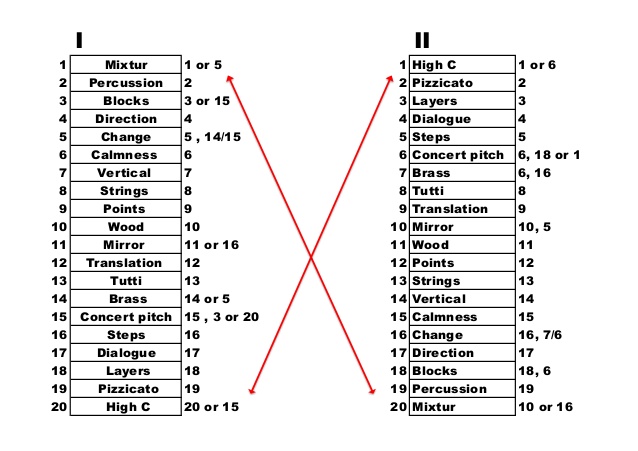
    MIXTUR is in 20 sections, each an independent "Moment" with no real sequentially thematic connection with the previous or next Moment.  The Moments each have a somewhat descriptive title and for a given performance can be played in sequence from Moment 1 to Moment 20, or alternatively in backwards sequence (there are also several Moments which can be switched/exchanged with each other for a performance - see below).  Stockhausen preferred that the forward sequence be played, and then the backwards sequence, with an intermission in between.  The orchestra is organized into 5 instrument type groups (percussion, woodwinds, brass, bowed strings, plucked strings), and in the table below, the 5 right hand columns indicate which of the groups play for each Moment.  Sometimes a plucked (pizzicato) string group will play bowed (arco) material, and vice-versa.  These are indicated by parentheses.
     Finally, in Moments 4 and 11 there are 2 "inserts", which could be considered a kind of improvisation or "flashback".  Jerome Kohl's 1981 thesis "Serial and Nonserial Techniques in the Music of Karlheinz Stockhausen from 1962-1968", observes that these inserts are the first time Stockhausen uses a "quote" from an external music source in his work (preceding TELEMUSIK).  Stockhausen, for his part, describes the quote of "La Marseillaise" as being "played backwards" (in a 2001 interview with Julia Spinoza (FAZ)).
 
Moment Name Dur. Description Instrument Groups
1 Mixture 0:34 7 accented string plucks, short wind phrases, high harmonic string figures, muted brass swells and a climactic cymbal strike ("unknown timbre glissandi") PERCUSSION
WINDS - BRASS
BOWED & PIZZ STRINGS
(TUTTI)
2 Percussion 1:05 Ringing cymbal and gong strikes, also gong "scraping" with plastic/cardboard boxes (no RM) PERCUSSION
3 Blocks 2:13 6 blocks of sound with different dynamics, separated by silences.  The blocks each have unique combinations of "micro-rhythms", pitch bends and mutes. WINDS - BRASS
BOWED & PIZZ STRINGS
4 Direction 1:22 Blocks of layered pizz. strings and scraped percussion, with 1 "diving" horn blast, followed by 2 waves of rising/falling tremoli
INSERT: "Marienlied/folksong" near the end
PERCUSSION
WINDS - BRASS
PIZZ STRINGS
5 Exchanges 0:30 11 Group attacks  WINDS - BRASS
BOWED & PIZZ STRINGS
6 Calm 4:36 Long tones with various brass muting and string bowing techniques (harmonics, col legno, etc…). RM causes beating/pulsations. BRASS
BOWED STRINGS
7 Vertical 0:46 2 accented blocks of trembling/scraped percussion and agitated strings PERCUSSION
BOWED & PIZZ STRINGS
8 Bowed Strings 0:34 Polyphonic layers BOWED STRINGS
9 Points 0:45 Isolated attacks with various muted brass and strings WINDS - BRASS
BOWED STRINGS
10 Wood (winds) 1:31 Low register trills and tremoli WINDS
BOWED STRINGS
11 Mirror 2:12 Short figures accompanied by a low background drone and a brief swooping trombone
INSERT: 1st measure of "La Marseillaise" occurs twice
TUTTI
12 Translation 1:13 Winds and pizz strings enter individually with tremoli, soon becoming "points".  Tremolo texture then returns, finally ending with metal percussion hits. PERCUSSION
WINDS
PIZZ STRINGS
13 Tutti 2:18 Lurching staccato figures, broken by tremoli, trills, long tones and silences TUTTI
14 Brass 0:39 Drone, with melodic accents in the middle section BRASS
15 Concert-Tuning 0:34 "Tune up", with one silent break in between WINDS - BRASS
BOWED & PIZZ STRINGS
16 Steps 0:49 Winds trill up/down, brass modulates with mutes, strings plucked and bowed in large intervals WINDS - BRASS
BOWED & PIZZ STRINGS
17 Dialogue 0:28 Dialogue PERCUSSION - BRASS
18 Layers 1:42 Polyphonic layers of synchronous accents, short figures, and independent "points" BRASS
BOWED & PIZZ STRINGS
19 Pizzicato 1:52 Alternating high and low plucked clusters, decelerating and then accelerating (features a violin "solo" of 1 isolated note in the accelerating section). PIZZ STRINGS
20 High C 0:30 Ascent to high C WINDS
BOWED STRINGS

     It's kind of interesting that the option to "switch around" the Moments (below) is not exercised very often.  In any other composition by another composer this would be the focal point for a program book, but MIXTUR already has so many pernicious technical challenges (controlling the ring modulation mix, the aleatoric nature of the score, dynamic balancing), that most ensembles play it "straight" (with the notable exception of Jonathan Nott and Ensemble Intercontemporain's performance in 2004).
This graphic from a slide presentation by Lindsay Vickery
shows the interchangeable Moments.

Score
     MIXTUR's score uses a fair amount of "aleatoric" notation.  In other words, he sometimes provides pitches or melodic fragments, but leaves it to the performer as to when or how they are played.  Some "pointillistic" sections are literally dots on the page which the player interprets as floating noteheads.  This kind of notation is ideal for ring-modulation purposes, since it's more effective to distort textures and blocks of sound, rather than melodies.   During rehearsals, players are urged to decide how they are going to play their "free-choice" parts before the performance and notate it in spaces provided.

     Originally scored for full orchestra (Work 45), Stockhausen made a 2nd version for reduced orchestra (Work 46).  In 2003, Stockhausen decided to write out all the free-choice aleatory parts, creating a fully "realised" version.  This is called MIXTUR 2003 (Work 47).

     Except for the percussion (which is never ring-modulated), each of these 4 groups has it's own ring modulation part, labeled in the score as "~". The indications at top with the arrows (<-5->) are the number of beats for each section.   Below are some pages from the 2nd version of MIXTUR.

Trumpet, high horns, low horns and trombone
(© Universal Edition)
This page shows winds (H) and plucked strings (P).
The middle section is a melodic set from which the players can choose 10 notes to play.
(© Universal Edition)
"Direction" Page 2
Percussion (SCH) and plucked strings, with a little bit of wind and brass.  Percussion plays 1, 2 and 2 hits, indicated in the boxes.
(© Universal Edition)
"Tutti" Page 1
Graphic notation with dots
(© Universal Edition)


In MIXTUR 2003, Stockhausen wrote out all of the aleatoric notation into standard notation.  A good example can be seen in the CD cover to Stockhausen Edition CD 106, which shows the last part of the "BLOCKS" moment (pg 2 of Moment 3).
(click to enlarge, © www.karlheinzstockhausen.org)
Here is the original score passage (with a little bit of cut & paste editing for clarity)(click to enlarge, © Universal Edition)

Live Performance
2 possible stage set ups for the 5 instrumental groups.
"Sch" = Percussion, H/S/P/B are the other 4 groups.
(© www.karlheinzstockhausen.org)


MIXTUR, Opus 16 1/2 (Forward Version):
Ensemble DIAGONAL, Director: Jürg Henneberger, Live Electronics: Cornelius Bohn
Hochschule für Musik Basel in collaboration with the Elektronischen Studio Basel ESB, Volkshaus Basel, 20.03.2013

Do It Yourself Ring Modulation
     Many sound editing software programs have a ring modulation effect which can be applied to a sound file.  I use Adobe Audition (3) and in the group effect "Generate" there is an effect called "Tones".  If no audio is already imported, you can first create a steady pitch, for example 440 (A).  Then by clicking Tones again and choosing the "Modulate" option, it is possible to enter in a control sine-wave in the "Base Frequency" box.  A sine-wave glissando can also be created by entering in Initial and Final values (after "unlocking" the base frequency settings).  Use of the Preview button is pretty handy for typing in different values to hear their effect immediately.

Stockhausen Edition CD 106: MIXTUR 2003
     The release of MIXTUR 2003 on Stockhausen CD 106 is in 2 single tracks (Forwards Version and Backwards Version).  Here are my approximate timings for the individual Moments for these 2 tracks.

MIXTUR 2003:
Forwards
Version
Track 1
(Time)
Mixture 0:07
Percussion 0:28
Blocks 1:54
Direction 4:28
Exchanges 5:57
Calm 6:39
Vertical 11:12
Bowed Strings 12:10
Points 12:44
Wood (winds) 13:34
Mirror 14:30
Translation 17:13
Tutti 18:30
Brass 21:12
Concert-Pitch 22:09
Steps 22:43
Dialogue 23:37
Layers 24:10
Pizzicato Strings 25:35
High C 27:21
spaSPACEScess
MIXTUR 2003:
Backwards
Version
Track 2
(Time)
High C 0:07
Pizzicato Strings 0:42
Layers 2:25
Dialogue 3:46
Steps 4:21
Concert-Pitch 5:16
Brass 5:52
Tutti 6:49
Translation 9:18
Mirror 10:40
Wood (winds) 13:23
Points 14:15
Bowed Strings 15:01
Vertical 15:34
Calmness 16:33
Changes 20:57
Direction 21:37
Blocks 23:06
Percussion 25:50
Mixture 26:50


Sound Impressions
     The very first time I heard MIXTUR I actually thought there was something wrong with the record.  It really sounded to me like the vinyl grooves had deteriorated in some way.  Over time I got used to it and became very fascinated by the new textures obtained from the ring-modulated instrumental groups.  However I personally feel the effect works better in the later piano pieces, such as in MANTRA or MICHAEL's REISE.  Somehow the timbral complexity of the orchestral instruments almost makes the additional ring modulated sounds almost too complex for me.  However what I probably enjoy even more than the ring modulation is the orchestral writing itself.  In fact I think MIXTUR could stand perfectly well on its own even without the electronics.  Stockhausen uses a real smorgasbord of textural composition techniques to get these 20 Moments to sound independent and have their own identity.  In fact I may like this collection of Moments even more than the primary "moment form" work, MOMENTE.  In any case, there are many depths to plumb in this piece.

     Update: Since hearing the new CD 106 recording of MIXTUR 2003, I've decided that the ring modulation actually works quite well and, at least in this recording, the modulation successfully creates a new sound-world of unknown textures ("Calm" is certainly a highlight).  In this version, the percussion part also sometimes seems to sound ring-modulated somehow... (to great effect).


Links
Sound samples, tracks listings and CD ordering
Purchase the Score
MIXTUR Wiki
Stockhausen's Notes on MIXTUR for Large Ensemble (PDF)
Stockhausen's Notes on MIXTUR for Small Ensemble
Stockhausen's Notes on MIXTUR 2003 (PDF)
Sonoloco Review of MIXTUR
Albrecht Moritz on MIXTUR
MIXTUR 2003 Report by Robert Worby 
Serial and Non-serial Techniques in the Music of Karlheinz Stockhausen from 1962-1968 (Jerome Kohl)